
All civil societies are alike for one reason: “We live together because social organization provides the efficient means for achieving our individual objectives and not because society offers us a means of arriving at some transcendental common bliss” (Buchanan 1975, 1). Form, as always, follows function. Unique differences among nominally open societies follow from (i) adverse internal forces (i.e., “enemies”); (ii) external surroundings (resources, competitors, environment, etc.); (iii) the degree of social homogeneity and harmony; and (iv) the common stock of metaphysical resources (e.g., cultures, theistic and secular religious tenets, etc.).
The distinguished logician and philosopher of science Karl Popper’s ([1945] 2020) book, The Open Society and Its Enemies, distinguishes broadly between (i) societies that are “open” (i.e., nominally “free” and classically liberal); and (ii) those that are “closed” (i.e., substantially lacking individual freedom for some or all individuals). These two forms represent the end points of an indefinitely broad continuum of alternative social arrangements, including classical liberalism, federalism, individualism, market capitalism, democracy, constitutionalism, parliamentarianism, progressive liberalism, collectivism, socialism, communitarianism, communism (i.e., communitarianism without the whimsy), tyranny, and mob rule. Popper’s open-society concept echoes the constitutional model designed by America’s founders, while America itself increasingly resembles Popper’s vision of a closed society.
Popper ([1945] 2020, 118) compactly summarizes his twofold open/closed social model this way:
The first consists of government of which we can get rid without bloodshed—for example, by way of general elections; that is to say, the social institutions provide means by which the ruler may be dismissed by the ruled, and the social traditions ensure that these institutions will not easily be destroyed by those who are in power. The second type consists of governments which the ruled cannot get rid of except by way of a successful revolution—that is to say, in most cases, not at all. I suggest the term “democracy” as a shorthand label for a government of the first type, and the term “tyranny” or “dictatorship” for the second.
This statement properly implies that democracy is a process (often identified with simple majority voting)—a costly (see Downs 1957) and also, for reasons to be discussed, an inefficient and ultimately perilous basis for self-government within an open society (see, e.g., Deneen 2018, 157). Democracy therefore must be exercised cautiously, wisely, and responsibly. Nowadays, however, democracy is imagined as being the promise of specific Utopian social outcomes, a collection of benefits and entitlement rights (all rights, in fact) conferred by progressive-liberal states, initially to create a more perfect open society, and subsequently to repair catastrophic social and economic harms caused by radical policies: “Liberalism has failed because liberalism has succeeded. As it becomes fully itself, it generates endemic pathologies more rapidly and pervasively than it is able to produce Band-aids and veils to cover them” (Deneen 2018, 179; see also Minogue 2010, 38). When expected benefits fail to arise, disappointments become grievances, which grow into protests, political correctness, cancellation, alienation, resentment, anger, rage, and class warfare. The democratic process fails to produce universally satisfying outcomes when one-size-fits-all policies and programs are decided by simple majority legislative votes or imposed arbitrarily by quasi-autonomous agencies.
Popper ([1945] 2020) identifies throughout the book—both by ideological methodology and by name—the philosophical “enemies” of an open society. The two greatest ideological enemies, by Popper’s standards, are (i) “positivism” (i.e., governing by pure reason and a priori speculations, without regard to reality and experience, in order to achieve wistful social perfection); and (ii) “historicism” (i.e., drawing conclusions from history in order to make predictions about the future, as if the future were preordained by God). Personalized enemies include philosophers Plato, G. W. F Hegel, and Karl Marx, but conspicuously not the protoprogressive positive theorist and historicist (and subsequently presidential) Woodrow Wilson, who advocated for increasing the role of national government by “wresting the Constitution to strange and unimagined places” in the course of creating an administrative state that is unelected, generously compensated, indefinitely tenured, and unaccountable outside of itself (Pestritto 2005, 113, quoting Wilson). Political historian Ronald Pestritto (2005, 74) explains how existing “political institutions were to become both more democratic and less important” under Wilson’s governmental model, within which the people collectively matter but individuals taken separately do not. Wilson, like Plato and Marx—but unlike Popper—expressly discounted the Lumpenproletariat’s competence for democratic self-government, articulating instead “strong criticism for universal suffrage and proclaim[ing] repeatedly that people were not capable of governing themselves without extensive guidance” (Pestritto 2005, 212).
Popper’s account also overlooks the positivist and self-styled “social physicist” Auguste Comte, whom economist and Nobelist F. A. Hayek considered a greater enemy of the open society than Popper’s bête noir, the historicist Hegel (Hayek [1955] 1964, 109, 105–206, and passim). Also missing from Popper’s account are radical utilitarians, especially Jeremy Bentham and John Stuart Mill, and positive humanists, including Herbert Croly and Thomas Dewey (see Montanye 2020).
Following Plato (whom he otherwise attacks sharply), Popper ([1945] 2020, 581–82n4) identifies two potentially detrimental open-society paradoxes. First, an open society may choose, short of revolution, to surrender sufficient freedom to become functionally closed. Second, an open society can become excessively tolerant of its internal enemies, and so disintegrate eventually into chaos, violence, coercion, tyranny, and mob rule, a Hobbesian state of nature that Plato imagined lurking a few careless missteps beneath democracy. Popper nevertheless stresses that open societies generally promote individual freedom (at least on balance) instead of obliging individuals to live by positive rules that they would not choose of their own volition (338, 480). He also stresses that open societies must adopt what amounts to quasi-progressive “piecemeal social engineering” (i.e., continuous reform at the margins) to accommodate changing circumstances (e.g., changing technology, changing mores, and social entropy increases that occur naturally in the absence of continuous energy inputs) (338). Conversely, he rejects radically discontinuous (i.e., “holistic”) Utopian reforms, arguing that “the politician should limit himself to fighting against evils, instead of fighting for ‘positive’ or ‘higher’ values, such as happiness” (480), the link between Utopianism and terror being well established (see Liulevicius 2003). Political scientist Patrick Deneen (2018, 196) argues that “the impulse to devise a new and better political theory in the wake of liberalism’s simultaneous triumph and demise is a temptation that must be resisted.”
Popper’s narrow focus and social democratic bent are apparent in his initially gentle treatment of Karl Marx—Hegel’s most prominent disciple—about whom Popper ([1945] 2020, 406), like economist Joseph Schumpeter and other scholars of the time, initially wrote kindly: “Marx’s faith, I believe, was fundamentally a faith in the open society.” Popper’s ardor cooled once evidence from Marx’s correspondence with collaborator Friedrich Engels reveled him to be “less of a humanitarian, and less of a lover of humanity than he is made to appear in [early editions of] my book. [Marx was instead] a man who saw in ‘the proletariat’ mainly an instrument for his own personal ambition. . . . The evidence itself is shattering” (511). Only a few of Popper’s contemporaries, principally Ludwig von Mises ([1922] 1981) and F. A. Hayek ([1944] 1994), fully anticipated the degree of closure, politicization, coercion, and distorted production and consumption incentives that flowed perforce from Marx’s radical social vision. Schumpeter, for his part, did not advocate directly for socialism, arguing only that “there is nothing wrong with the pure logic of socialism [defined narrowly as representing the public ownership of the means of production; i.e., of capital, risk, and entrepreneurship]. . . . The only authority standing for denial that we need mention is Professor L. von Mises” (Schumpeter [1942] 2008, 172, 200; see also Mises [1922] 1981).
Philosopher Isaiah Berlin (1997, 194; see also 2006, 161) independently popularized Popper’s argument for open societies and individual freedom, and against positivism and social historicism:
The first of these political senses of freedom or liberty (I shall use both words to mean the same), which (following much precedent) I shall call the “negative” sense, which is involved in the answer to the question “What is the area within which the subject—a person or group of persons—is or should be left to do or be what he is able to do or be, without interference by other persons?” The second, which I shall call the “positive” sense, is involved in the answer to the question “What, or who, is the source of control or interference that can determine someone to do, or be, this rather than that?”
Berlin’s characterization of “positive” freedom (an allusion, perhaps, to Comte’s voluminous Positive Polity writings) is rightly regarded as a misnomer because, as both Berlin and Popper acknowledge, positive freedom perforce entails denials of individual liberty. Berlin (1997, 205–6) explains that
it is one thing to say that I may be coerced for my own good, which I am too blind to see: this may, on occasion, be for my benefit; indeed it may enlarge the scope of my liberty. It is another to say that if it is my good, then I am not being coerced, for I have willed it, whether I know it or not, and am free (or “truly” free) even while my poor earthly body and foolish mind bitterly reject it, and struggle with the greatest desperation against those who seek, however benevolently, to impose it.
Libertarianism accepts in principle Popper’s and Berlin’s accounts of freedom and liberty. By contrast, progressive theorists, from Woodrow Wilson (and Theodore Roosevelt before him) to the present, strongly disagree. Economist and Nobelist Joseph Stiglitz (2024, xvi–xvii) argues, à la Jean-Jacques Rousseau, that “forcing someone to do something he of his own volition would not do . . . can, in some cases, enhance everyone’s freedom, even the freedom of those being coerced.” Stiglitz does not identify the measure by which “enhanced” freedom for coerced individuals and others is to be gauged. Progressive legal scholar Cass Sunstein similarly argues that “people’s decisions are based on whims, second-order preferences, aspirations, judgments, drives of various kinds, and so forth, each potentially coming to the fore depending on the context. . . . In all these cases, I suggest, a democracy should be free and is perhaps obliged to override private preferences” (Sunstein 1997, 46, 14; see also Thaler and Sunstein 2008; Sunstein 2014). Theorists of this ilk, like Plato, Hegel, and Marx, personify philosophical enemies of the open society.
The notion that the state is both the author and the agent of individual freedom has its roots in the writings of Thomas Hobbes and John Locke, but has blossomed since into radical utilitarian and progressive forms of coercion. The upshot is a conflict between incompatible “negative” and “positive” visions that rends open societies asunder. (See Sowell 2007 for a comprehensive discussion of the conflict between negatively “constrained” and positively “unconstrained” visions.)
Libertarianism, by comparison, judges the degree of a society’s openness by the extent of coercion that its statutes and administrative rules entail, and that its courts otherwise allow: it “is strictly a political philosophy and confined to what the use of violence should be in social life” (Rothbard 1998a, 141; see also Rothbard 1998b). This standard is less objective than Popper’s minimalist test for democracy. Nevertheless, it is the preferred gauge of whether a nominally open society is actually fulfilling the legitimate expectations of both individual citizens and the people taken as a whole.
Despite Popper’s overt commitment to liberty—that is, as “a man who is alive to the dangers inherent in all forms of power and authority” (Popper [1963] 2002, xiii)—his “shorthand” analogy between the open society on one hand and democracy on the other hand (Popper [1945] 2020, 118), raises concerns. Popper’s writings follow the social democratic tradition of Whig reformers and cold-war liberals. His criticisms of Plato indicate an awareness of the process by which democratic politics can degrade an open society into mob rule and tyranny, but he nevertheless advocates for “piecemeal social engineering” (338) without regard for the inevitably coercive course and adverse social consequences of such engineering.
America’s founders, by comparison, distinguished clearly between democracy on one hand and, on the other hand, a republican form of government, which they prayed would survive in perpetuity. Writing in The Federalist no. 10, James Madison, following Plato, explained that “a pure democracy, by which I mean, a society consisting of a small number of citizens, who assemble and administer the government in person, can admit of no cure for the mischiefs of faction. . . . Hence it is, that such democracies have ever been spectacles of turbulence and contention; have ever been found incompatible with personal security, or the rights of property; and have, in general, been as short in their lives, as they have been violent in their deaths” (Hamilton et al. [1787–1788] 2001, 91). The founder’s view, like that of libertarians today, embodies classical liberal principles.
Popper’s exposition nevertheless provides a useful framework for contemporary analysis of open societies, although it does not consider the evolutionary process by which open societies emerge, peak, subsequently become closed, and ultimately fail (see Olson 1982, 1993; Acemoglu and Robinson 2006; Deneen 2018; Dalio 2021). This article focuses both upon the framework of an open society and also upon the many and varied intrinsic enemies that weaken it to the point of closure. The first section below visualizes the structure of an open society. The next two sections address intrinsic threats to its existence and introduce two constitutionally feasible defenses against them.
Visualizing an Open Society
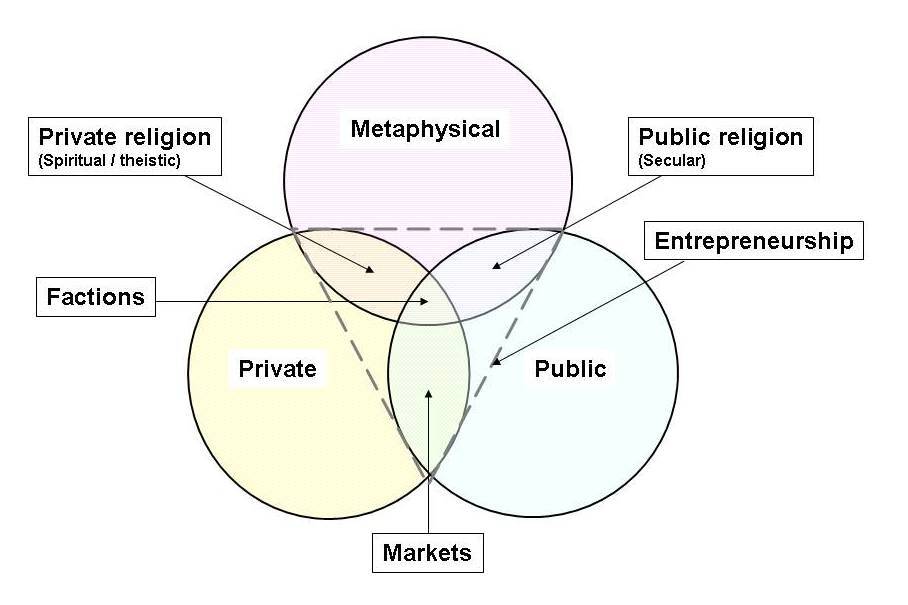
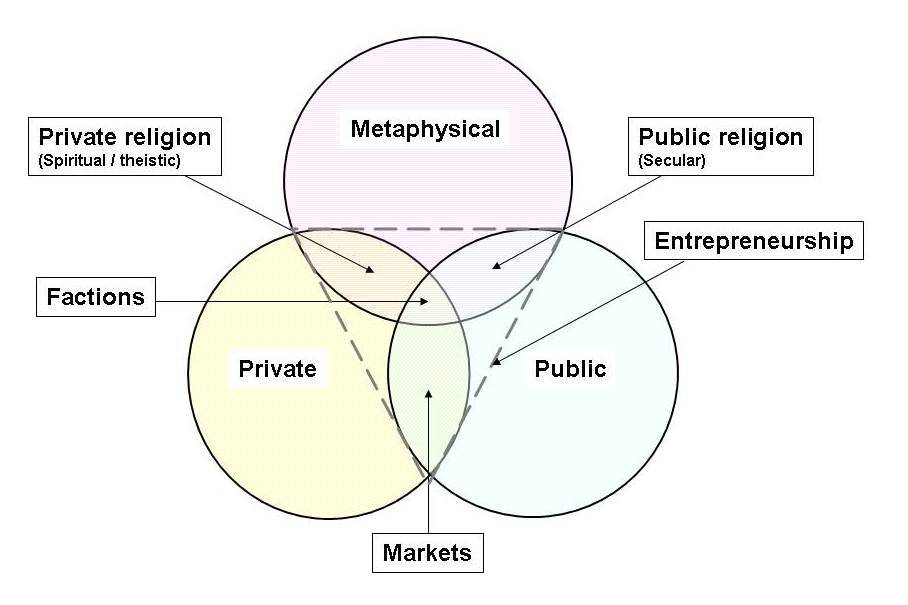
All societies comprise three magisterial divisions existing within a surrounding environment of scarcity and hostility: (i) public; (ii) private; and (iii) metaphysical (Montanye 2017). Overlaps between and among these social magisteria create five conceptual realms that define particular regions of political, social, and economic activity: (i–ii) public and private religion; (iii) markets for goods and services; (iv) factions; and (v) a virtual realm, defined by combined overlaps, comprising public and private entrepreneurship. Other factors (e.g., resource scarcity, competitors, ideologies, etc.) determine the extent, shape, and significance of these magisteria and realms.
These relationships are visualized, for purposes of this article, in figure 1, and are explained in the subsections that follow. The orderliness and proportions of this illustration are not intended to suggest either a static or an evenly rotating society existing in perpetual equilibrium, or to exemplify an open society’s relative proportions.
The Three Social Magisteria
Descriptions of the three magisteria are straightforward. Greater complexity and significance lie within the five derivative realms created by their overlaps.
The Public Magisterium
The public magisterium corresponds with the political aspect of Popper’s open society. It comprises a social commons that includes, among other things, a written constitution and other sacred, albeit secular (i.e., “civil”), scriptures; symbols and artifacts; anthems; governing institutions; laws; administrative rules; and other unifying social elements, such as festive national holidays and pseudopatriotic sporting events. Within it, common costs and benefits (i.e., “public goods”) are administered for the well-being of all members of an open society. Its function, as Wilson imagined it, is to manage a society’s business, but not to micromanage the private affairs of its individuals. This magisterium also facilitates public and private institutions alike by synthesizing cooperation, reciprocity, trust, trustworthiness, and exchange relationships via statutory law, and by protecting individual rights in life, liberty, and property within the metes and bounds of public constitutions (both written and unwritten), statutes, and regulations. The open society becomes progressively closed as this magisterium expands to eclipse its private and metaphysical counterparts.
The Private Magisterium
The private magisterium comprises the conceptual space within which “human society must primarily be considered something pertaining to the spiritual” (Vatican 1995, para. 1886). Individuals here interact with gods, family members, friends, and like-minded acquaintances, principally for the purpose of alleviating scarcity’s privately adverse effects. Interactions depend largely upon cooperation, reciprocity, exchange, trust, and trustworthiness—rational behaviors sometimes dubbed “humanomics”—rather than upon formal rules and prices. Interpersonal relationships are fostered and maintained through metaphysical notions of moral and ethical behavior as expressed through social norms (see E. A. Posner 2000).
The Metaphysical Magisterium
The metaphysical magisterium corresponds with the epistemic aspect of Popper’s open society. It represents a conceptual social commons comprising the universe of inherent human propensities, along with collective social experiences, collective knowledge, and philosophical, social, and political ideals. More specifically, it harbors a universe of ideologies, dogmas, doctrines, rationalizations and justifications, romantic myths and stylized histories, national and local pride, cultures, superstitions, rituals, moral values, ethical virtues, language and meanings, metaphors, memes, and so on. Beliefs regarding alternative socioeconomic systems (e.g., classical liberalism, market capitalism, progressivism, collectivism, etc.) also reside here. In short, this magisterium contains the grist for a society’s unwritten constitution, and also provides the repository for mankind’s innate sense of pragmatic “natural” rights and duties.
The Five Realms
Overlaps between and among the three magisteria create four discrete realms and one virtual realm, as depicted in figure 1.
Two Religious Realms
The word “religion” is a cognate of the Latin verb ligare, whose literal meaning is “to bind” and whose figurative meaning is “to unite.” In sum,
All religions, regardless of their basis, are institutionalized behavioral responses to the “evil” represented by the scarcity of economic resources. All religions serve to unify populations for defense, cooperation, and production, and to proffer apologias for evil’s persistence in the presence of presumptively omnipotent, omniscient, and benevolent sovereigns (e.g., gods, kings, elected and appointed officials, informal leaders, etc.). All religions comprise a mix of metaphysical constructs and all religious “truths” are pragmatic in the sense of reflecting “what works,” to what end it works, and for whom it works. . . . Modern political economy and philosophy entail faith-based approaches to creating “the greatest good for the greatest number,” often implying the backing of Divine wisdom. The unintended consequence of this arrangement is the panoply of man-made evils [i.e., “enemies”] that are characteristic of illiberal democratic majorities and theocratic states. (Montanye 2024b, 37)
Two religious realms are depicted in figure 1: one public and mostly secular; the other private and essentially spiritual and theistic. The gap between them corresponds with Thomas Jefferson’s idealized “high wall of separation” between church and state. Objects of divine and secular worship matter relatively little because what sets divine worship apart from secular worship is “the declaration of our opinion of whom we do worship.” The two are otherwise “words of the same action in degree” (Hobbes [1642] 1949, 192). Theistic religion’s presumptive public role nevertheless generates considerable discussion and controversy: Today, Americans “live in a society which, on both left and right, has imported religious zeal into secular politics and exported politics into religion, bringing partisan polarization and animosity to levels unseen since the Civil War” (Rauch 2025, 5).
Scholars question whether “deified” civil authority constitutes a “substitute religion” or a “substitute for religion” (Burleigh 2007, 197). Either way, the debate correctly characterizes theistic and secular religious forms as broadly substitutable constructs whose ebbs and flows reflect relative costs and benefits.
The public religious realm. Prominent economist, cofounder of the American Economic Association, and ardent Christian socialist Richard Ely viewed the state as encompassing all of human existence. Weimar jurist Carl Schmitt ([1922] 2005, 36–37) conflated the essence of theistic and secular religions, observing that “all significant concepts of the modern theory of the state are secularized theological concepts.” Recognizing the role of shared theistic virtues for maintaining secular social order, President John Adams asserted that “our Constitution was made only for a moral and [theistically] religious people. It is wholly inadequate to the government of any other” (quoted in Will 2019, 479; Rauch 2025, 19). Alexis de Tocqueville ([1835] 2010, 476, 479) observed that “Americans mix Christianity and liberty so completely in their mind that it is nearly impossible to make them conceive one without the other. . . . I found them intimately joined the one to the other: they reigned together over the same soil.” Nevertheless, he wrote, theistic religion “among the Americans never directly takes part in the government of society, [and yet] must be considered as the first of their political institutions; for if it does not give them the taste for liberty, it singularly facilitates their use of it” (475).
Brookings Institution Senior Fellow Jonathan Rauch (2025, 2) therefore wonders “what happens to our liberal democracy if American Christianity is no longer able, or willing, to perform the functions on which our constitutional order depends?” Legal scholar and jurist Robert Bork provides a plausible answer: “A functioning rule of law requires that law be understood to have force and moral weight of its own, independent of the political and cultural struggles of the moment” (Bork 2003, 135; see also R. A. Posner 1999). Accordingly, written constitutions and statutes must stand on their own as inspirational secular scripture. Legal scholar and New Deal architect Thurman Arnold proposed that Americans be taught about constitutional government as a secular religious institution that frees individuals from such metaphysical notions as individualism and free markets (Goldberg 2007, 223). The US Supreme Court presently interprets the First Amendment’s proscription of theistic religious “establishment” and “practice” as narrowly permitting state-sponsored expressions of “secular deism” only.
Theistic religions constitute a public good in a homogeneous society, and so fit comfortably within the public religious realm. Not so within pluralistic societies, where competing theistic beliefs are socially divisive.
The private religious realm. The private religious realm comprises an array of theistic, spiritual, and secular beliefs and values. Philosopher William James ([1902] 1920, 31) viewed this realm as the realm of “the feelings, acts, and experiences of individual men in their solitude.” For the theologian Thomas Aquinas ([1274] 1953, 222), it was the seat of natural law: “There is in people an appetite for the good of their nature as rational, and this is proper to them, that they should know the truths about God and about living in society. . . . Whatever this involves is a matter of natural law.” Philosopher John Locke ([1689] 1988, 2:§172) saw this realm as containing that “which God hath given to be the Rule betwixt Man and Man, and the common bond whereby humane kind is united into one fellowship and society.”
The private religious realm is a chivalrous space in which nonmarket cooperation and reciprocity often trump formal legal arrangements, a realm in which Burkean sophisters, calculators, and economists are unwelcome (see, for example, Ellickson 1991; E. A. Posner 2000). Research by sociologist Robert Putnam (2000, 19, 66) found that “faith communities in which people worship together are arguably the single most important repository of social capital in America. . . . Nearly half of all associational memberships in America are church related, half of all personal philanthropy is religious in character, and half of all volunteering occurs in a religious context.” Subsequent research further revealed that “religious Americans are more trusting and (perhaps) more trustworthy” than other individuals (Putnam and Campbell 2010, 66, 443). By contrast, theologian H. Richard H. R. Niebuhr (1989, 1, 81) noted the “gangrenous corruption of a [secularly transactional] social life in which every promise, contract, treaty, and ‘word of honor’ is given and accepted in deception and distrust. . . . The massive law books and the great machinery of justice give evidence of the vast extent of fraud, deceit and disloyalty among men.”
The Market Realm
The market realm corresponds with the economic aspect of Popper’s open society. It integrates the voluntarily and spontaneously cooperative private magisterium with the public magisterium of formal laws, contracts, and institutions. This realm joins anonymous individuals into efficient economic relationships by matching consumer demand with commercial supply. Prices and production within open societies are determined by market forces. Within partially open and fully closed societies, by contrast, prices and production are determined to some extent by legislative and administrative fiat in order to achieve outcomes that combine economic efficiency, privately desired policies and programs, and normative moral considerations into compulsory social choices.
The Factional Realm
The factional realm is a region of socially wasteful, nonproductive, and counterproductive activity. It comprises individuals and groups that pursue nonmarket, public agendas that are at once privately beneficial and socially destructive. Factions represent “a city within a city; . . . an enemy within [the] walls” (Hobbes [1642] 1949, 149–50). Adam Smith characterized faction as being “the clamorous opportunity of partial interests,” for which the state is the primary instrument, and often its primary beneficiary as well (McCloskey 2016, 175–76, quoting Smith). Factional gains occur at the expense of outside individuals (Montanye 2003), thereby fueling uncivil and often violent conflicts. The factional realm prevents the private and public magisteria from achieving their full social potential, and dulls the market realm’s potential efficiency.
Factions are principal enemies of open societies. Philosopher David Hume ([1742] 2009, 58) observed that
as much as legislators and founders of states ought to be honoured and respected among men, as much ought the founders of sects and factions to be detested and hated; because the influence of faction is directly contrary to that of laws. Factions subvert government, render laws impotent, and beget the fiercest animosities among men of the same nation, who ought to give mutual assistance and protection to each other. And what should render the founders of parties more odious is the difficulty of extirpating these weeds, when once they have taken root in any state.
Philosopher Jean-Jacques Rousseau ([1762] 1954, 164) echoed Hume with words that resonate even more profoundly today: “Let us suppose now a state in which the social bond has begun to wear thin. It has, we assume, entered upon its decline; particular interests have begun to make themselves felt in it, and narrower associations to affect decisions of the wider group. The common interest, in such a state, is clouded over, and encounters opposition; votes cease to be unanimous; the general will is no longer the will of everybody.”
The convergent views of Hobbes, Hume, and Rousseau culminate in Madison’s treatment of faction in The Federalist nos. 10 and 51. There, Madison defined “faction” as “a number of citizens, whether amounting to a majority or minority of the whole, who are united and actuated by some common impulse of passion, or of interest, adverse to the rights of other citizens, or to the permanent and aggregate interests of the community. . . . A religious sect may degenerate into a political faction in a part of the Confederacy. . . . The latent causes of faction are thus sown in the nature of man.” Madison recognized that factions are best controlled, not by proscriptive laws, but instead by enabling “ambition . . . to counteract ambition” (Hamilton et al. [1787–1788] 2001, 88–88, 89, 273). Libertarianism follows Madison’s vision.
The Virtual Realm of Entrepreneurship
The preceding four realms, along with slivers from each of the three magisteria, comprise a triangular virtual realm of entrepreneurship, as indicated by the dashed lines in figure 1. Popper tacitly characterized entrepreneurial efforts within an open society as “piecemeal social engineering” occurring within the public magisterium and distinguished it from radical and revolutionary social change (which is also a consequence of entrepreneurial effort). Figure 1 illustrates that entrepreneurship is a broader social phenomenon.
Entrepreneurship operates within both the private and public magisteria: “The various complementary factors of production cannot come together spontaneously. They need to be combined by the purposive efforts of men aiming at certain ends and motivated by the urge to improve their state of satisfaction” (Mises [1949] 2008, 249). Entrepreneurship stimulates the productive relationships and institutions that are synonymous with prosperous societies, which cannot arise, grow, and prolong their existence without it (see Montanye 2006). Entrepreneurial factions, by comparison, constitute enemies of the open society, and cause its disintegration into closure.
Enemies of the Open Society
It is quite wrong to blame democracy for the political shortcomings of a democratic [i.e., open] state. We should rather blame ourselves, that is to say, the citizens of a democratic state. . . . The seed of the decay and disunion of a perfect state does not spring up in the state itself, but rather in the individuals; it is rooted in the imperfection of the human soul, of human nature; or more precisely, in the fact that the race of men is liable to degenerate.
—Karl Popper, The Open Society and Its Enemies
The liberal project is ultimately self-contradictory and . . . culminates in the twin depletions of moral and material reservoirs upon which it has relied. Taken to its logical conclusion, liberalism’s end game is unsustainable in every aspect.
—Patrick Deneen, Why Liberalism Failed
Open societies ideally choose governmental structures and policies that control opportunities for internal enemies to prosper. That is, they rationally accommodate enemies up to the point where the additional cost of controlling or extirpating them exceeds the cost of allowing them to operate—in the argot of economics, up to the point where long-run costs and benefits are equated at the margins; beyond this optimal point lurks totalitarianism. There is no free social lunch; thus, all societies—whether classically constitutional (i.e., “rule utilitarian”), or progressively ad hoc (i.e., “act utilitarian”), or else an uneasy amalgam of both—are obliged to accept the rough with the smooth as an unpleasant reality of social life. The myriad opportunities for mischief that an open society rationally admits ensure that enemies will persist, and even flourish, regardless of organizational form. If its enemies are left unchecked, however, an open society will be brought low by demagogic politicians and others who advocate closing the open society on the ironic pretexts first of perfecting it and eventually of saving it from itself.
The thick literature contributed by Popper and others addresses enemies that corrupt open societies when left unchecked. Some scholars attribute social closure to specific causes (market capitalism is a common culprit among progressive economists, sociologists, and legalists). Others envision an evolutionary process of naturally occurring social cycles that are driven by inherent human weaknesses (see Deneen 2018; Dalio 2021) and are rendered chaotically unpredictable by the nonlinear dynamics of complex, adaptive social systems (see Montanye 2024a, 191–95). If these theories—which are addressed more fully in a later section—are correct, then openness is merely a passing phase that precedes a liberal society’s eventual closure, revolution, and reset.
For Plato, the greatest enemy is the inevitability of ideal societies’ degenerating from their perfect Form—that is, societies in which the wise lead the ignorant as a matter of natural right before cycling through lesser alternative Forms, ultimately degenerating penultimately into democracy, and then becoming democratized into chaos, mob rule, and tyranny. Wilson (1908) finds the enemy of America’s open society in its constitutional checks-and-balances scheme, which slows governmental responses to rapidly changing circumstances. Political commentator George Will (2019, 127) sees America’s open society being weakened by the tyranny of law, rules, regulations, and coercion; that is, suffering slow death via legiscide and lawfare. Sociologist Robert Nisbet ([1975] 2000, 219) remarks that “law is vital—formal, statute law—but when every relationship in society becomes a potentially legal relationship, expressed in adversary fashion, the very juices of the social bond dry up, the social impulse atrophies.” Bad behavior then comes to be defended (and incentivized) by asserting, truthfully but disingenuously, that no statutory laws were broken (see Minogue 2010, 337).
Capitalism is often regarded as a great enemy of open societies. Marx imagined initially beneficial capitalist societies collapsing eventually into communism, a telos dictated by the unfolding of Hegelian historicism along materialistic lines. Economists Andrei Shleifer and Robert Vishny (1998) equate social weakening and collapse with “government pathologies.” Other economists perceive the enemy to be social inequality as wrought by capitalism (e.g., Stiglitz 2012). Sociologist Daniel Bell ([1976] 1996), among others, argues broadly that market capitalism’s prosperity and the consequent rise of progressive governmental pseudobenevolence, as manifested through entitlement programs, distorts democracy’s cultural foundations, the upshot being a paradox of market capitalism accomplishing “exactly what was soon to be denounced as its worst feature” (Hirschman [1977] 2013, 132; see also Schumpeter [1942] 2008; Ferguson 2013). Schumpeter, who argues that modern democracy “rose along with capitalism and in causal connection with it,” describes how
the capitalist process . . . eventually decreases the importance of the function by which the capitalist class lives. . . . It tends [also] to wear away protective strata, to break down its own defenses, to disperse the garrisons of its entrenchments. . . . Capitalism creates a critical frame of mind which, after having destroyed the moral authority of so many other institutions, in the end turns against its own; the bourgeois finds to his amazement that the rationalist attitude does not stop at credentials of kings and popes but goes on to attack private property and the whole scheme of bourgeois values. The bourgeois fortress thus becomes politically defenseless. (Schumpeter [1942] 2008, 143; see also Deneen 2018; Dalio 2021)
Contra Schumpeter, libertarians argue that capitalism arose and has survived despite democracy rather than being in league with it.
Stiglitz (2024, 286) capsulizes the gravamen of these (and numerous other) doomsayers: “Neoliberalism is not economically sustainable, and it undermines the sustainability of democracy—just the opposite of what Hayek and [Milton] Friedman claimed.” Other commentators opine that America itself has become intrinsically unsustainable given the reign of sundry other internal enemies, including structural deficits, an exploding national debt, unconscionably large and unfunded liabilities, periodic inflations, a lagging birth rate, increasing pluralism, and the pursuit of private interests, all of which, in combination, supersede not only the overarching national interest, but also the search for objective social and political truths (see Dalio 2021; Rauch 2021). Dalio and others argue that classical liberalism’s open society actually faltered and largely failed decades ago, and that we are presently living amid its remnants and ruins (see, e.g., Lowi 1979; Deneen 2018; Dalio 2021).
Progressive liberalism ostensibly represents a strategic political and administrative response to the perceived enemies of open societies. Its presence can be viewed in two ways: first, as representing an intermediate stage between laissez-faire and socialism, between individualism and collectivism (i.e., communitarianism and communism), and between freedom and servility; and second, as representing a teleological stage of political evolution (see, e.g., Fukuyama 1992). Author Jonah Goldberg (2007, 119, 130) explains that
progressivism was largely a middle-class movement equally opposed to runaway capitalism above and Marxist realism below. Progressives hoped to find a middle course between the two, what the fascists called the “Third Way” or what Richard Ely, mentor to both Wilson and Roosevelt and founder of the American Economic Association, called the “golden mean” between laissez-faire individualism and Marxist socialism. Their chief desire was to impose a unifying, totalitarian moral order that regulated the individual inside his home and out. . . . The Third Way holds that we can have capitalism and socialism, individual liberty and absolute unity.
Third Way progressivism’s pervasive regulatory control over the means of production obviates classical socialism’s key “public ownership” requirement. Accordingly, it has more in common with classical Marxism, the radical utilitarianism of Bentham and Mill, and the American humanist movement spawned by Croly and Dewey than it has in common with Wilsonian progressivism (see Montanye 2020, 2024b). Market capitalism’s widespread prosperity and flourishing have actually impeded the growth of these alternative “isms,” despite ironically funding the intellectual, cultural, and political elites who work tirelessly to impose them.
One significant aspect of Third Way progressivism is the evisceration of protection for private rights in life, liberty, and property, including such penumbral rights as freedom to contract and the unencumbered right to earn a living through honest efforts. Property rights enjoyed protected status under English common law (see Blackstone [1765] 1979, 135), hence the Fifth Amendment’s “taking” and “compensation” clauses. By contrast, property rights are protected nowadays either as positive gifts of the state, or else as inadvertent statutory loopholes attributable to sloppy legislative draftsmanship (Drucker 1993, 127). The upshot, as described by legal scholar Richard Epstein (1985, x), is that “the state now can rise above the rights of the persons whom it represents; it is allowed to assert novel rights that it cannot derive from the persons whom it benefits. Private property once may have been conceived as a barrier to government power, but today that barrier is easily overcome, almost for the asking. . . . Under the present law the institution of private property places scant limitation upon the size and direction of the government activities that are characteristic of the modern welfare state.”
The discussion so far richly suggests that the open society supports a host of intrinsic enemies stretching well beyond those identified by Popper, and yet this litany remains far from complete. A more thorough list of especially concerning enemies includes (i) pluralism; (ii) compromise; (iii) entitlement and rent seeking; (iv) the democratization of democracy; (v) the liberalization of liberalism; (vi) incivility; (vii) the surveillance state; (viii) government by judiciary; (ix) political corruption; and (x) simple majority voting. These enemies are considered separately in the subsections below.
Pluralism
France’s postwar president, General Charles de Gaulle, once mused: “How can anyone govern a country with 246 varieties of cheese?” The general was Trumpishly indifferent about the number, but entirely correct in spirit, as the below engraving by Pieter van der Borcht the Elder illustrates.
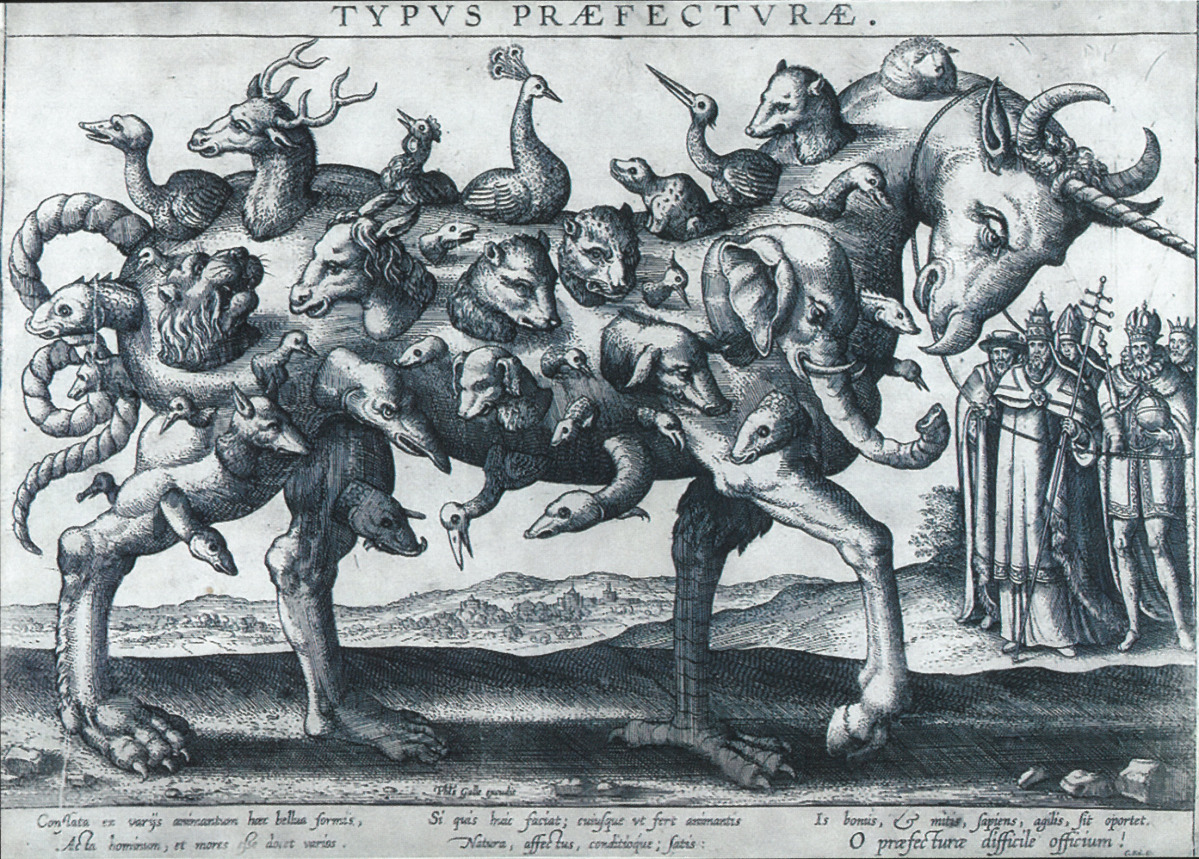
Pluralism is not synonymous with either Madison’s “diversity in the faculties of men” (Hamilton et al. [1787–1788] 2001, 89) or John Stuart Mill’s ([1859] 1977, 257) view that “the interests of truth require a diversity of opinions” given “the imperfect state of the human mind.” Political theorist Tracy B. Strong (2005, xvi, xlix), in his foreword to Schmitt’s treatise on sovereignty, explains that the shortcoming of progressive “liberal normativism” regarding pluralism is attributable to
the assumption that a state can ultimately rest on a set of mutually agreed-to procedures and rules that trump particular claims and necessities. Pluralism is thus not a condition on which politics, and therefore eventually the state, can be founded. Politics rests rather on the equality of its citizens . . . and thus the collective differentiation from other such groups: this is the “friend/enemy” distinction, or more accurately, the distinction that makes politics possible. It is, one might say, its transcendental presupposition. . . . As Lord Balfour noted in his introduction to Walter Bagehot’s The English Constitution, “The whole political machinery presupposes a people so fundamentally at one that they can safely afford to bicker; and so sure of their own moderation that they are not dangerously disturbed by the never-ending din of political conflict.”
Philosopher Leo Strauss (1953, 131) explains that “only a society small enough to permit mutual trust is small enough to permit mutual responsibility or supervision—the supervision of actions or manners which is indispensable for a society concerned with the perfection of its members.” Will (2019, 8) notes that “government cannot hope to provide happiness to all. Rather, the most it can reasonably expect to provide are the conditions under which happiness, as each defines it, can be pursued, as each is equipped, by nature or nurture, to do.” Schumpeter ([1942] 2008, 254–55) explains that
even if the opinions and desires of individual citizens were perfectly definite and independent data [existed] for the democratic process to work with, and if everyone acted on them with ideal rationality and promptitude, it would not necessarily follow that the political decisions produced by that process from the raw material of those individual volitions would represent anything that could in any convincing way be called the will of the people. It is not only conceivable but, whenever individual wills are much divided, very likely that the political decisions produced will not conform to “what people really want.” Nor can it be replied that, if not exactly what they want, they will get a “fair compromise.”
Economist and Nobelist Kenneth Arrow’s (1963) “impossibility theorem” demonstrates empirically that no social welfare function can satisfy all of the implicit assumptions that progressive welfare-maximizing engineering necessarily entails. Epstein (1998, 192) argues that “there is no disembodied public interest as such, but only a large and complex set of private interests held by each individual in accordance with a set of values and preferences that others might not share.” Accordingly, “it would be naive to imagine that wise deliberation can survive the constant pounding from self-interested political behavior. Benevolence in public institutions has a short half-life no matter how noble its original intentions” (150).
A plausible escape from this dilemma is to imagine that the law of large numbers nominally “assures” that every individual is likely to realize some coincidental gains over a lifetime, although this escape cannot guarantee that those gains will equal or exceed the coerced sacrifices that are demanded. And even this hypothetical outcome cannot occur under progressive policies derived from philosopher John Rawls’s (1971, 183–221) “difference principle,” which holds that incremental policy decisions and benefits ought to benefit only the least advantaged members of society.
Wilson fancifully rejects the founders’ belief that “a diversity of interest will always underlie the extended republic, [contending instead] that ‘history would overcome such particularism with an increasing unity of mind’” (Pestritto 2005, 6, quoting Wilson). Experience teaches instead that naturally evolving assimilation of this sort cannot be taken for granted, no matter how much it is wished for.
Compromise
Compromise, by some accounts, serves as a political lubricant that keeps governmental wheels turning: “The lack of compromise contributes to instability in politics, policies, and programs, with large economic and social consequences” (Stiglitz 2024, 288). Compromise, however, is not analogous with efficient “trade-offs,” a concept intrinsic to economics (xvi). It differs as well from the overly dramatic notion that compromise “is a dynamic, creative force in its own right, constantly recruiting new voices and ideas to break deadlocks and solve problems” (Rauch 2021, 86). Political compromise instead extends the traditional practice of “logrolling,” by which legislative votes are traded to satisfy personal and factional interests. It creates wasteful second-best outcomes that dissipate a portion of the wealth created by market capitalism. Open societies eventually fall below the point where they can fake stability and prosperity by cutting fiscal and policy babies in half.
Political compromise blossomed as progressive government overthrew constitutional limitations by claiming that history, along with advances in scientific social administration and planning, justified (if not necessitated) the change. Political theorist Theodore Lowi (1979, 70) explains that bargained compromises emerged once the promised benefits of “scientific” progressive planning became conspicuously illusory. He equates compromise with “interest-group liberalism,” which confuses the public interest with “the amalgamation of various claims” and represents “a vulgarized version of the pluralist model of modern political science” (51). Lowi concludes that progressive compromise has become “so well established in our minds and in our legitimized and government-sponsored power patterns that we are obliged to call it the Second Republic of the United States. . . . Only a radical, organized constitutional revolt will succeed now where once a sustained intellectual attack might have been sufficient” (91).
Entitlement and Rent Seeking
Lowi (1979, 51, 125, 93) explains that “a government of statutes without standards may produce pluralism, but it is a pluralism of privilege and tight access . . . [which] has wrapped public policies in shrouds of illegitimacy and ineffectiveness.” Lowi ranks political patronage of all kinds as being the “most insidious threat to liberty because it is the threat that liberal democracy poses to itself” (see Cook 2007, 247, quoting Lowi).
Modern entitlement seeking arose in force following, in succession, the Civil Rights Act of 1964, the subsequent rise of affirmative action policies and programs, and the inevitable flood of positive legal expansions. These occurrences, along with the rising tide of incivility that followed (as discussed in a subsection below), emerged coincident with sharply rising postwar economic prosperity and everyone’s desire to capture for themselves a proportionately larger share of it (Montanye 2003, 2016, 75–81). One regrettable upshot (among many) is the emergence of a welfare-addicted class of entitled individuals.
Bell ([1976] 1996, 23, 233) writes about “a revolution of rising entitlements. . . . The particular demand will vary with time and place. They are, however, not just the claims of minorities, the poor, the disadvantaged; they are the claims of all groups in the society, claims for protections and rights—in short, for entitlements.” Will (2019, 93, 262) adds that “more and more, what government does consists of transferring wealth to members of groups that the government has decided are entitled to transfers. And the word ‘rights’ is coming to be used interchangeably with ‘entitlements.’ Hence, the unspoken but unmistakable supposition is that the more entitlements people enjoy, the more rights they have—and that rights, like entitlements, trickle down from government. . . . The problem is that the weight of benevolent, redistributive government can be inimical to the economic growth that such government presupposes.” Bork (2003, 139) explains that “rights become weapons in political, cultural, and legal struggles . . . accompanied, of course, by the redistribution of wealth and privilege. . . . The result is a clamorous public square, with groups pitted against one another, and the consequent deterioration of the community’s fabric.”
Patronage is not limited to entitlement-seeking behavior. Business factions long have manipulated democracy to produce laws and regulations that create windfall business profits (“rents”) at the expense of competitors, consumers, and open societies generally. Rent-seeking efforts conducted through lobbying efforts, campaign support, kickbacks, and outright bribery are socially wasteful and destructive activities, as economics’ “public choice” program amply demonstrates.
The Democratization of Democracy
Political theorist Kenneth Minogue (2010, 12, 9, 12) argues that open societies are undermined by the democratic process itself: “Democratization is the most dramatic of all the corruptions of modernity in which the inherited practice of balance is to be replaced by a single ideal believed to solve all problems. . . . Few activities are immune from proposals that they ought to be democratized. . . . The moral life can no more be isolated from this drive than anything else. It too must be democratized.” Rauch (2021) adds that democratization causes the pursuit of personal and political interests to displace the pursuit of objective truth within open societies, thereby diminishing the chestnut “marketplace of ideas” ideal.
Author and editor Michael Korda (1975, 217–53) defines “democratization” specifically as the “democratic” ascendance of individuals into leadership ranks, which is another of the many social trends that began in the aftermath of the 1964 Civil Rights Act. Korda speaks specifically to the rise of women in business, but his observations apply equally well to all “underrepresented” groups, and to all areas of social activity. One characteristic of democratization, observes Korda, is that women and minorities “are just more free to break the rules and get away with it. They’re not even expected to know what the rules are” (247). Stiglitz (2024, 119) extrapolates the effects of democratization by noting that “children of the rich may grow up feeling entitled, thinking the world owes them and that they have a right to break whatever rules society creates.” One upshot, according to Korda, is that democratization is coincident with the tendency for real decision-making power and authority to move elsewhere. This observation inadvertently highlights Wilson’s progressive goal of making political and politicized institutions “both more democratic and less important” (Pestritto 2021, 74).
The Liberalization of Liberalism
Of the twentieth century’s three great secular religions—communism, fascism, and liberalism (including American democratic fundamentalism)—only liberalism remains in repute as the best hope for ensuring human freedom and liberty. Liberalism, however, acquired different meanings over the century as the concept evolved from its classical form (negative freedom) to its current, progressive form (positive freedom), and is presently edging liberal societies closer to an authoritative form of ersatz freedom that ostensibly aims to restore the glory of some earlier era by means other than the restoration of classical liberal principles (see Rossiter 1948; Higgs 1987). This evolution arguably reflects the natural unfolding of a combined social, political, and economic cycle.
The cyclical social model proffered by prominent quantitative macroeconomic analyst and investor Ray Dalio (2021, 52) posits and documents open societies arising from the ruins of their predecessors, subsequently peaking, and then descending (i.e., closing) into a chaotic storm of economic and policy swings that ultimately deteriorate into a new ruin, and the consequent beginning of a new cycle. Dalio interprets his macroindicators as showing that the US has already completed 70 percent of its present cycle, which “has not yet [as of 2021] crossed the line into . . . civil war/revolution, when the active fighting begins, but internal conflict is high and rising” (360; see also 149–91, 340, and current updates at economicprinciples.org). Deneen (2018, 180, 191, 4) similarly observes that “the end of liberalism is in sight[,] . . . the gathering wreckage of liberalism’s twilight years. . . . We should rightly wonder whether America is not in the early days of its eternal life but rather approaching the end of the natural cycle of corruption and decay.” If so, then political history cannot be teleological—sophisticated contrary arguments by Marx, Wilson, Fukuyama, and others notwithstanding.
The phases of Dalio’s open-society cycle resemble the familiar bell curve: (i) the “rise” and “peak” phases correspond with market capitalism’s development within a framework of classical liberalism; (ii) the subsequent “decline” phase corresponds with increasingly fettered market capitalism, mixed with growing social discontent, both within a political framework of progressive liberalism; and (iii) an inevitable “civil war/revolution” phase follows that leads to an era of authoritarian liberalism, which proposes to restore the prosperity and flourishing of an earlier phase. Dalio’s quantitative model, like Deneen’s political science model, is consistent with the evolutionary course of dynamic, complex, adaptive systems.
Deneen (2018, 62) describes the death spiral caused by the liberalization of liberalism itself:
The expansion of liberalism rests upon a vicious and reinforcing cycle in which state expansion secures the end of individual fragmentation, in turn requiring further state expansion to control a society without shared norms, practices, or beliefs. Liberalism thus increasingly requires a legal and administrative regime, driven by the imperative of replacing all nonliberal forms of support for human flourishing (such as schools, medicine, and charity), and hollowing out any deeply held sense of shared future or fate among the citizenry. Informal relationships are replaced by administrative directives, political policies, and legal mandates, undermining voluntary civic membership and requiring an ever-expanding state apparatus to ensure social cooperation.
Unlike Dalio, whose model predicts eventual revolutions and restarts, Deneen (xv) argues instead that “the better course lies not in any political revolution but in the patient encouragement of new forms of community that can serve as havens in our depersonalized political and economic order”—a wishful task given that inherent human nature never has evolved beyond the foundations of classical liberalism, not even in the face of extreme coercion, tyranny, and terror.
Incivility
Popper regards “reasonableness” as being the only plausible alternative to violence. The alternative to reasonableness is radical Utopianism, which Popper ([1963] 2002, 482) describes as being “dangerous, pernicious, and self-defeating.” Utopianism constitutes a secular religion comprising an indefinitely large number of competing creeds that cannot be reconciled through rational argument. None of these creeds is intrinsically viable within open societies, thus creating a widespread sense of frustration, nihilism, and eventual incivility as wishful thinking and lofty expectations fail to produce desirable outcomes (483). These consequences, of course, are inescapable burdens that open societies must grin and bear to some extent. Of late, however, they have escalated into verbal and physical manifestations of targeted political anger, hatreds, and domestic terrorism, which are met in turn by demands for an authoritatively liberal state to forcefully restore and maintain public order, and to restore social ideals.
Rising incivility is casually observable, both within private life (e.g., aggressive and predatory behavior occurring within such public institutions as K–12 schools) and also in the willful and strategically contentious demeanor of public officials at all levels. Incivility adversely affects both the process of deliberative democracy and the spontaneous private processes of trust, cooperation, and reciprocity.
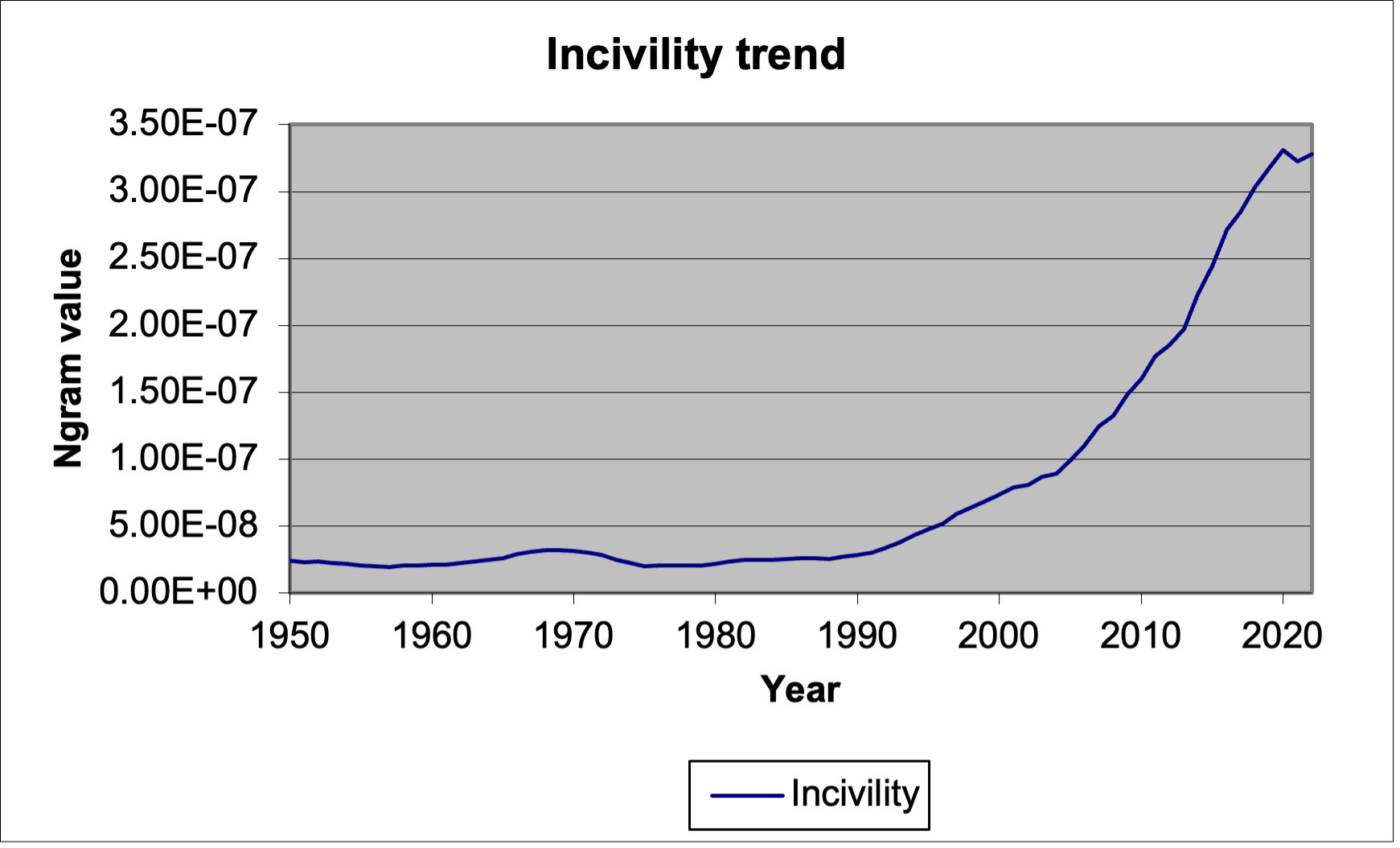
Acute incivility has become a structural part of progressive society (Montanye 2021b). Rising scholarly interest in its causes and effects is indicated by the frequency with which the word “incivility” appears in the text of published books, as revealed by the Google Books Ngram Viewer (1950–2022). Ngrams have become a standard tool for studying social shifts “based upon the premise that books are a tangible and public representation of culture” (Putnam 2020, 169). Increasing scholarly interest in “incivility” is depicted in figure 2.
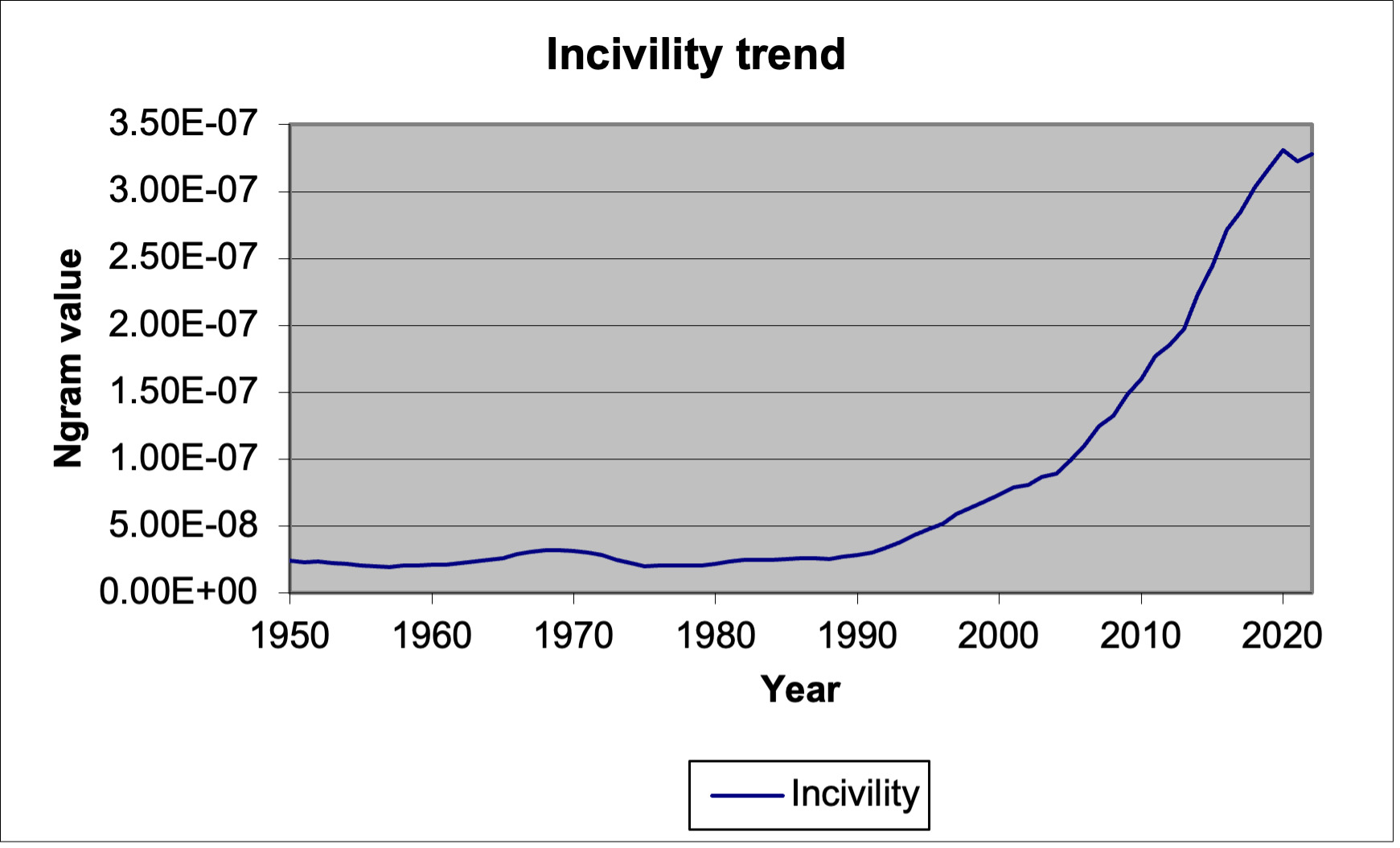
Supreme Court Justice Louis Brandeis’s dissent in Olmstead v. United States (227 U.S. 438, 485 (1928)) established the premise that government teaches by example rather than by principle. Incivility, by this light, grows and spreads when, as now, government itself increasingly displays a lack of both common decency and respect for the life, liberty, and property of its citizens.
The Surveillance State
State surveillance heralds an open society’s movement toward closure and decline: “The threat and evidence of declining civic norms require centralized surveillance, highly visible police presence, and a carceral state to control the effects of its own successes while diminishing civic trust and mutual commitment” (Deneen 2018, 63). An influential journal article by political scholars George L. Kelling and James Q. Wilson (1982, 3) argues that spontaneous behavioral norms inevitably “lead to the breakdown of community controls” and ultimately to social chaos. Historian Nicholas Kittrie (1995, 9) documents “the erosion of the historic pillars upon which the legitimacy of authority traditionally has been based (divine rights, nationalism, the social contract, and majoritarianism) has greatly weakened both the ideological and institutional edifices of public order during the second half, and particularly the final quarter, of the twentieth century. Increasingly, therefore, internal conflicts and violence have become the rule rather than the exception in the domestic affairs (political, religious, and familial) of states and lesser communities.” This pattern continues.
Surveillance, both public and private, has increased accordingly. The dystopic future of surveillance is glimpsed in China’s system of social credit, under which
citizens have a “social” account. They are credited when they behave according to the wishes of the state and debited when they do not. This system, supported by mass surveillance, intends to incentivize people to act in the way China’s leaders want. But the real intent is to create internalized social norms. China is attempting to develop a better system to motivate its citizens toward its state-directed goals than that of either Soviet Russia or Nazi Germany, with less reliance on explicit coercion and greater success in voluntary “cooperation,” so there are fewer dissenters and resisters. Westerners are revulsed by this twenty-first-century version of Orwell’s 1984. (Stiglitz 2024, 159)
Revulsed? Certainly so when state behavior is thus characterized as thinly veiled coercion, and yet not when it is gently recharacterized and promoted by progressives as social “nudging” (see Thaler and Sunstein 2008; Sunstein 2014).
Perhaps worst of all, digitized surveillance and low-cost data storage have removed the open society’s benevolent capacity to forget.
Government by Judiciary
Progressive social thinker Walter Lippmann (1943, 237) noted that “the purpose of liberal reform is to accommodate the social order to the new economy; that end can be achieved only by continual and far reaching reform of the social order. . . . Necessarily, liberal [i.e., progressive] reforms run counter to much that the law now tolerates and promotes.” As noted above, Wilson earlier averred that progressivism’s objectives could be achieved “only by wresting the Constitution to strange and as yet unimagined places” (Pestritto 2005, 113, quoting Wilson). Progressive advances since then have elevated judges and justices—many of whom are unelected and enjoy lifetime tenure—to sovereign status within America’s nominally open society. Rather than applying the black letter of the law, progressive judges now mix ambiguous statutory language, interpreted facts, and idiosyncratic moral values, the results being unpredictable “rule by men” decisions. Judges thereby abandon their role as impartial referees, becoming instead players in the game.
At the national level, notes the legal historian Raoul Berger (1977, 408), “the [Supreme] Court is truly a ‘continuing constitutional convention,’ constantly engaged in revising the Constitution, a role clearly withheld from the Court. Such conduct impels one to conclude that the Justices are become a law unto themselves.” Bork (1990) attributes this transformation to “the political seduction of the law.” He warns that “abstract ideals can never be realized in practice, but the search for cosmic justice continues and drives courts on, carrying them away from the only task they are even tolerably fit to perform [i.e., the task of applying the law as written]” (Bork 2003, 139).
Lowi (1979, preface) observes that the progressive “Second Republic of the United States” operates largely under an unwritten constitution. Constitutional scholar Akhil Amar explains that “America’s unwritten constitution encompasses not only unwritten rules specifying the substantive content of the nation’s supreme law but also the rules clarifying the methods for determining the meaning of this supreme law. Since the written constitution does not come with a complete set of instructions about how it should be construed, we must go beyond the text to make sense of the text. Without an unwritten constitution of some sort, we would not even be able to properly identify the official written Constitution” (Amar 2012, x; see also Barrett 2025, 175–241). The gossamer text of this unwritten constitution exists within the metaphysical magisterium described earlier.
Pestritto (2021, 178–79, 218) concludes that today’s national administrative state “co-exists uneasily and often incoherently with the principles of constitutional government upon which the nation was founded and under which, at least in form, it continues to operate. . . . This state of affairs is also evident from the tortured logic of federal court decisions, as judges must regularly bow to the reality of the administrative state while doing so within the formal framework of legal or constitutional order that seems to provide little place for reality. . . . Modern administrative law largely focuses on sorting out power between judges and agency administrators.”
For better or for worse, this long-established dynamic appears to be changing. The Supreme Court’s opinion in Loper Bright Enterprises v. Raimondo (603 U.S. 369 (2024)) reversed its earlier progressive opinion in Chevron U.S.A., Inc. v. National Resources Defense Council (467 U.S. 837 (1984)), thereby overturning four decades of federal court decisions deferring to administrative agencies’ interpretation of ambiguous statutes (judicial deference nevertheless remains a progressive ideal). Moreover, the court has begun expanding the traditional constitutional scope of executive authority (a Wilsonian ideal, albeit one implicitly contingent upon the reigning executive’s political ideology), including (to modern progressives’ displeasure) increased executive authority over quasi-independent administrative agencies. In short, the court has begun restoring sovereign tripartite decision-making authority along the founders’ constitutional lines. Already, democratized politics is unavoidably (and regrettably) becoming more significant, rather than becoming less so, an upshot that is contrary to Wilson’s conflicting goals of making politics more democratic but also less important.
Political Corruption
“If men were angels,” wrote Madison in The Federalist no. 51, “no government would be necessary. If angels were to govern, neither external nor internal controls on government would be necessary” (Hamilton et al. [1787–1788] 2001, 273). Wilsonian progressivism nevertheless assumes that a sufficient quantity of angelic men can be recruited to govern and administer an open society with relatively little oversight. Instead, however, the democratization of open democratic societies has opened further the door for governance by men and women of unsuitable character, as occurs when “politics is reduced largely to a spectator sport, marketed and packaged as a distraction for a passive population. Elections provide the appearance of self-governance but mainly function to satiate any residual civic impulse before we return to our lives as employees and consumers” (Deneen 2018, 193).
Legal scholar and occasional political candidate Zephyr Teachout (2014, 57) notes that “in Madison’s [Constitutional Convention] notebook from the summer of 1787, the word corruption is scrawled in longhand fifty-four times. Corruption, influence, and bribery were discussed more often in the convention than factions, violence, or instability.” Corruption, in the form of “honest graft,” is a regrettable, yet unavoidable, nemesis within an open society. Recently, however, political corruption has assumed more pernicious forms. Politicians and judges, for example, now choose voters, rather than the other way around, by gerrymandering districts along ideological and racial lines.
Researchers Wendy Schiller and Charles Stewart III (2013, 1) explain that the impetus behind the Constitution’s Seventeenth Amendment (1913)—which provided for the direct election of senators, thereby overturning the founding provision of Section 3 of Article I—“lay in the perceived corruption and inefficiency that marked indirect election.” These authors conclude, however, that
the 17th Amendment has failed to deliver on its promise, and has produced a Senate that is even less responsive to voters than it was under the indirect election system. . . . The 17th Amendment was supposed to reduce the influence of wealthy elites, reduce the role of money in determining Senate election outcomes, and give incumbent senators the incentive to represent their constituents responsively. That it has failed to achieve such admirable goals makes it imperative that policymakers and scholars look deeper into the inherent flaws in the construction of the U.S. Senate, and that voters be wary of promises that go unmet. (1, 9)
The allure of public service often fails to attract ideal candidates, therefore obliging voters to elect least-bad representatives from slates of flawed candidates. Schumpeter ([1942] 2008, 290) observes that “there may be many ways in which politicians of sufficiently good quality can be secured. Thus far, however, experience seems to suggest that the only effective guarantee is in the existence of a social stratum, itself a product of a severely selective process, that takes to politics as a matter of course [i.e., Jefferson’s ‘natural aristocracy’].” Jurist and legal scholar Richard R. A. Posner (2010, 79) explains that political virtue and integrity become compromised by the intrinsic nature of the work itself: “The morality of political officials is not that of private persons. Officials must lie, dissemble, flatter, traduce, pander, to a degree that would be regarded as monstrous in private life.” Individuals excelling at these dark qualities succeed routinely to elected and appointed public offices in democratized societies, causing the wrong individuals to come to rule.
The intrinsic difficulty of finding qualified leaders and administrators within a democratized open society is compounded by a Gresham’s law of politics, whereby bad politicians and candidates drive better ones out of circulation as the latter surrender to frustration, disgust, physical threats, and so on. Teachout (2014, 246) documents the corrupting trend of “public servants” moving from public service to lobbying jobs: “In 1970, only 3 percent of senators and congresspeople leaving office became lobbyists: now over 50 percent do, and the numbers are growing. The likely career path of a congressperson is to become a lobbyist.” Politicians and administrators increasingly regard public service as a stepping stone to activities that often grind against the national interest. Popper’s implicit faith in the electoral process as guarantor of a society’s openness must be considered misplaced.
Simple Majority Voting
Deliberative democracy is a noble ideal that pluralism and politics reduce to romantic fiction. Deliberations rarely end in consensus, given the divergent interests of politicians and their constituents, and the high cost of achieving consensus even in best-case scenarios. The upshot is that policy issues, both great and small, and often embodying extreme compromises, are decided by narrow majority votes.
Bork (1971, 2–3) observes that “a Madisonian system is not completely democratic, if by ‘democratic’ we mean completely majoritarian. It assumes that in wide areas of life majorities are entitled to rule for no better reason [than that] they are majorities. . . . Minority tyranny occurs if the majority is prevented from ruling where its power is legitimate. Yet, quite obviously, neither the majority nor the minority can be trusted to define the freedom of the other.” Popper ([1945] 2020, 368) explains that “democracy cannot be fully characterized as the rule of the majority, although the institution of general elections is most important. For a majority might rule in a tyrannical way. . . . Thus if the men in power do not safeguard those institutions which secure to the minority the possibility of working for a peaceful change, then their rule is a tyranny.” Wilson, by comparison, fancifully imagined progressive democracies reflecting, not majority rule per se, but rather rule by a true national will (Pestritto 2005, 69).
Legislative voting represents a highly imperfect sampling of the popular will, and yet the process is expected to yield outcomes that virtually all citizens will accept, if only as being the best of all possible outcomes. Achieving consensus is impossible in a democratized, pluralistic society wherein politicians and political factions can oppose sensible legislative proposals unless their factions are guaranteed a disproportionate share of the expected gains (see Epstein 1998, 218).
Achieving democratized outcomes through simple majority voting might be acceptable when the stakes are small—smaller at least than the cost of reaching a consensus. Where the stakes are large, however, economists typically prefer voting schemes premised upon such efficiency concepts as Pareto optimality and Wicksellian virtual unanimity (Buchanan [1967] 1987, 285–86). The Constitution’s framers aptly prescribed supermajority voting rules for a few high-stakes matters, including congressional overrides of presidential vetoes, constitutional amendments, treaty ratifications, and impeachment trials. The Constitution regrettably does not require supermajorities for such other crucial matters as taxing, spending, and entitlements, which the framers may have regarded mistakenly as being commonsense issues.
The Open Society’s Defenses
The defense of democracy must consist in making anti-democratic experiments too costly for those who try them, much more costly than a democratic compromise.
—Karl Popper, The Open Society and Its Enemies
This democracy—the modern democracy—is not the rule of the many, but the rule of the whole.
—Woodrow Wilson, “The Modern Democratic State”
Popper’s ([1945] 2020, 338, 371) scant discussion of defenses against the open society’s enemies reduces to two key concepts: (i) using “piecemeal social engineering” to keep an open society in step and in tune with the times; and (ii) making antidemocratic experiments too costly for radical politicians and administrators to attempt. Progressives, by comparison, who often align themselves with Utopian visions, reject the notion of marginal adjustments, favoring instead radical and costly alternatives. Such alternatives tend to exacerbate the problems they are intended to rectify, while creating second-order problems that require subsequent remedies, often leaving progressive theorists to complain defensively that earlier attempts to restructure society failed because they were not permitted to go far enough, and to insist that “this” time is different (Pestritto 2021, 195–96). Falsification has no relevance in a progressive liberal society. “To call for the cures of liberalism’s ills by applying more liberal [i.e., progressive] measures . . . will only deepen our political, social, economic, and moral crisis” (Deneen 2018, 4).
Two constitutionally consistent and self-working, albeit partial, defenses against progressive closure within open societies are advanced below: (i) multiple administrative mandates; and (ii) supermajority voting.
Multiple Administrative Mandates
Congress long ago saddled the independent Federal Reserve Board with dual administrative mandates: (i) achieving price stability; and (ii) promoting high employment. These mandates conflict—low interest rates can lift employment (if only temporarily) but also stimulate price inflation. Monetary policy decisions thus are self-regulated by internal checks and balances that cause ambition to counteract ambition.
Similarly obliging all administrative agencies to balance opposing mandates would constrain their ability to rampage in any one direction.
Supermajority Voting
Simple legislative majorities govern many of the high-stakes issues that are not decided administratively. Unanimous consent is the ideal criterion for weighty decisions because it obviates misbegotten social and economic choices. Within pluralistic societies, however, conflicting desires, strategic politics, and high negotiating costs overwhelm the quest for unanimity. Some retreat from unanimity is therefore necessary, although discovering the objectively optimal level of legislative voting majorities has proved challenging (Montanye 2021a).
Statistician I. J. Good and public choice scholar Gordon Tullock (2004) address statistically the likelihood of erroneous decisions occurring within the Supreme Court’s simple majority voting scheme. The authors’ approach can be extended to encompass legislative voting schemes as well, yet there is little evidence that such an extension has been analyzed. The probability mathematics underlying the authors’ methodology is daunting, and especially cumbersome when the voting body is large. The authors note, however, that comparable probabilities of truth and error with respect to public decisions are “well approximated by the tail-area probability of a normal deviate,” as defined by the standard formula for the cumulative normal distribution associated with the familiar bell curve
r−s(r+s+1)1/2,
where r represents the number of majority votes, and s represents the complementary number of minority votes (Good and Tullock 2004, 488). Once values are calculated using the above formula, associated error probabilities can be read directly from published statistical tables, and also calculated using preprogrammed spreadsheet functions.
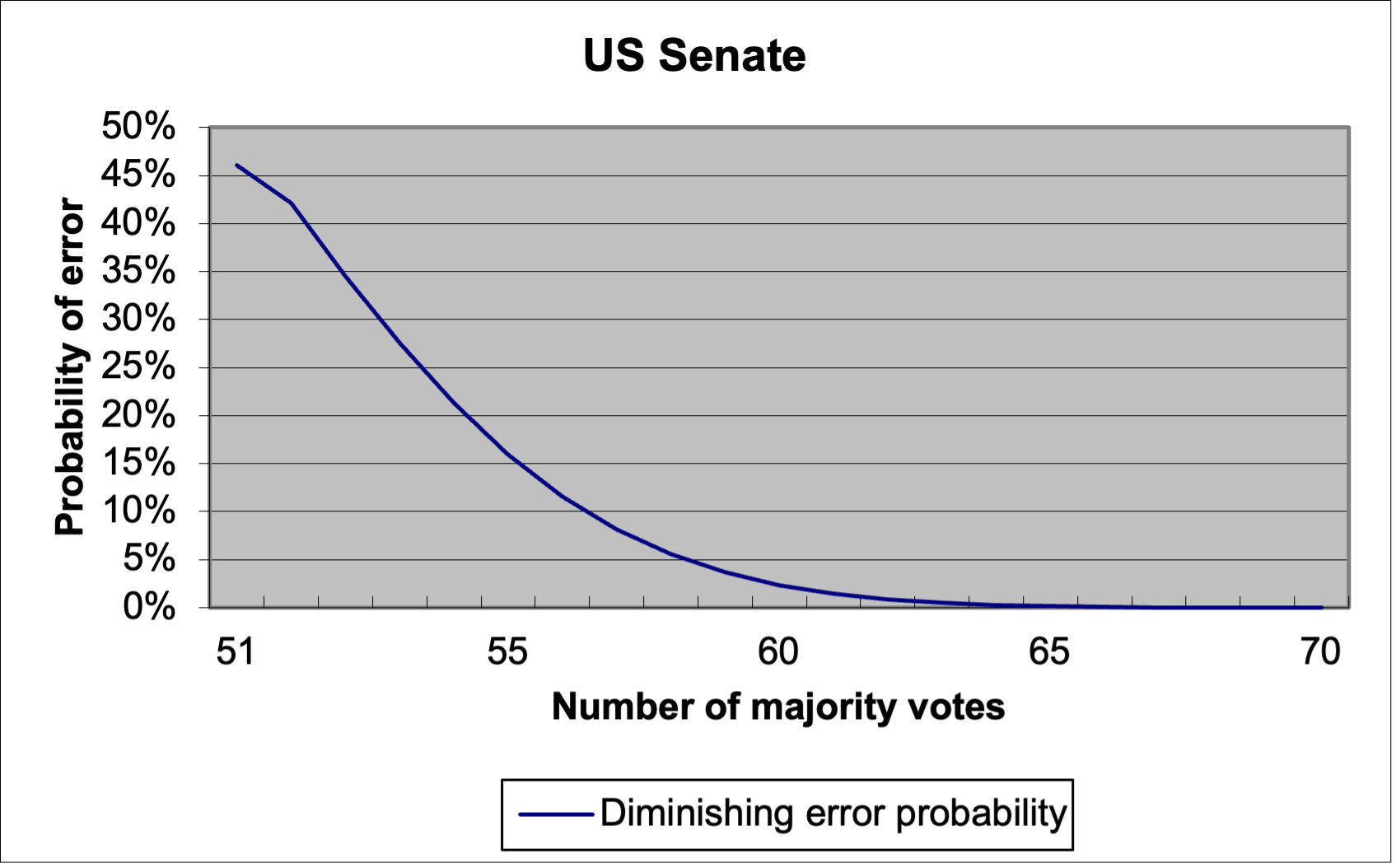
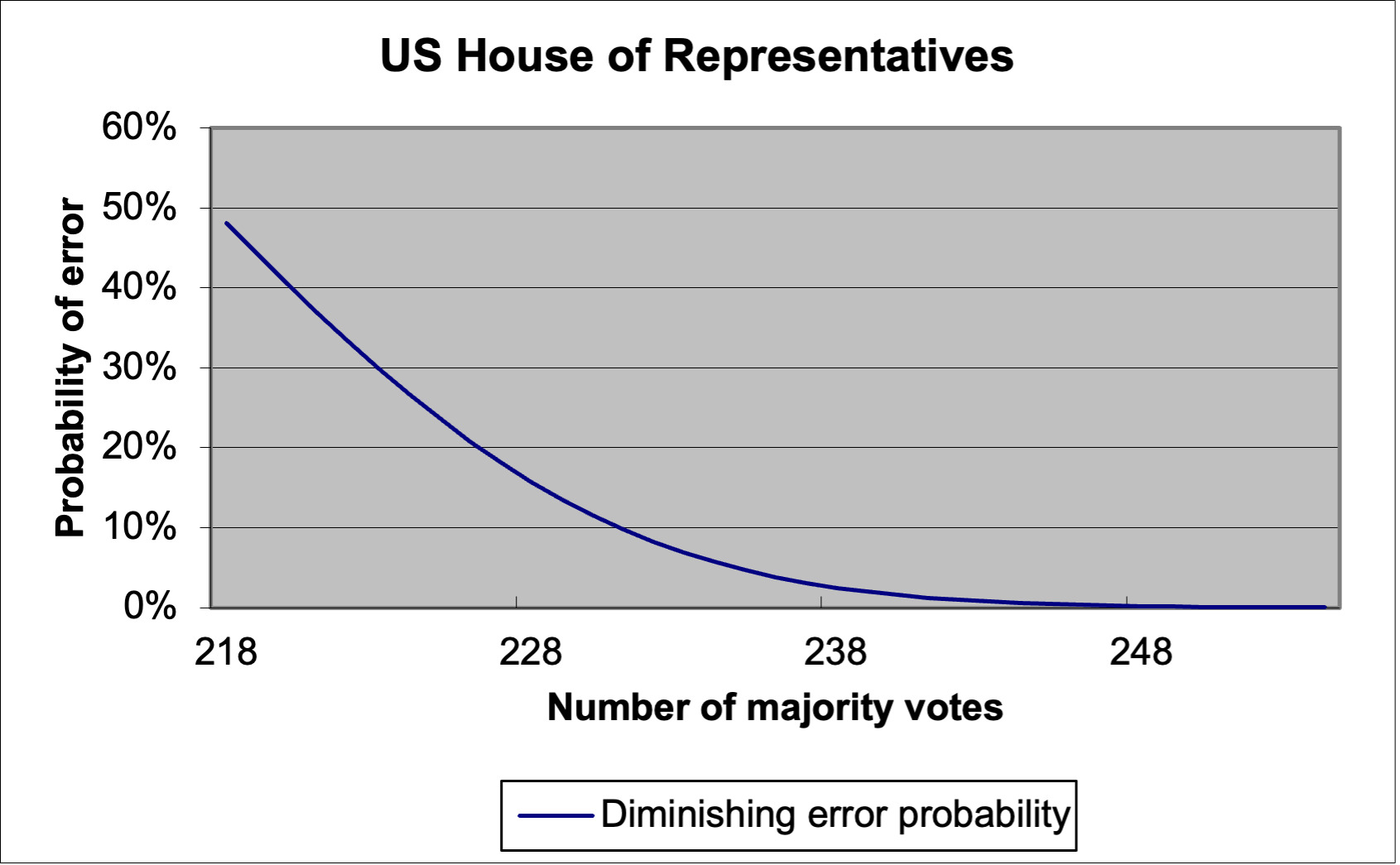
The probabilities of erroneous Senate and House decisions are depicted graphically in figures 3 and 4. The underlying data have been generated, for purposes of this article, using the cumulative normal distribution formula identified above. Error probabilities are shown on the charts’ vertical axis; the associated number of majority votes appears on the horizontal axis. These probabilities imply that appropriately large and politically diverse (à la Madison) supermajorities (i.e., those not overly democratized ideologically along party and other special-interest lines) are likely to adopt erroneous policies only rarely, a desirable outcome when taxing, spending, entitlements, and constitutionally implied “fundamental” rights (a.k.a. “unenumerated” and “natural” rights) are at issue (see Barrett 2025, 187–89).
Error probabilities for Senate voting (all one hundred members) are depicted in figure 3. The kink in the curve’s upper-left tail reflects the effect of a vice presidential tie-breaking vote.
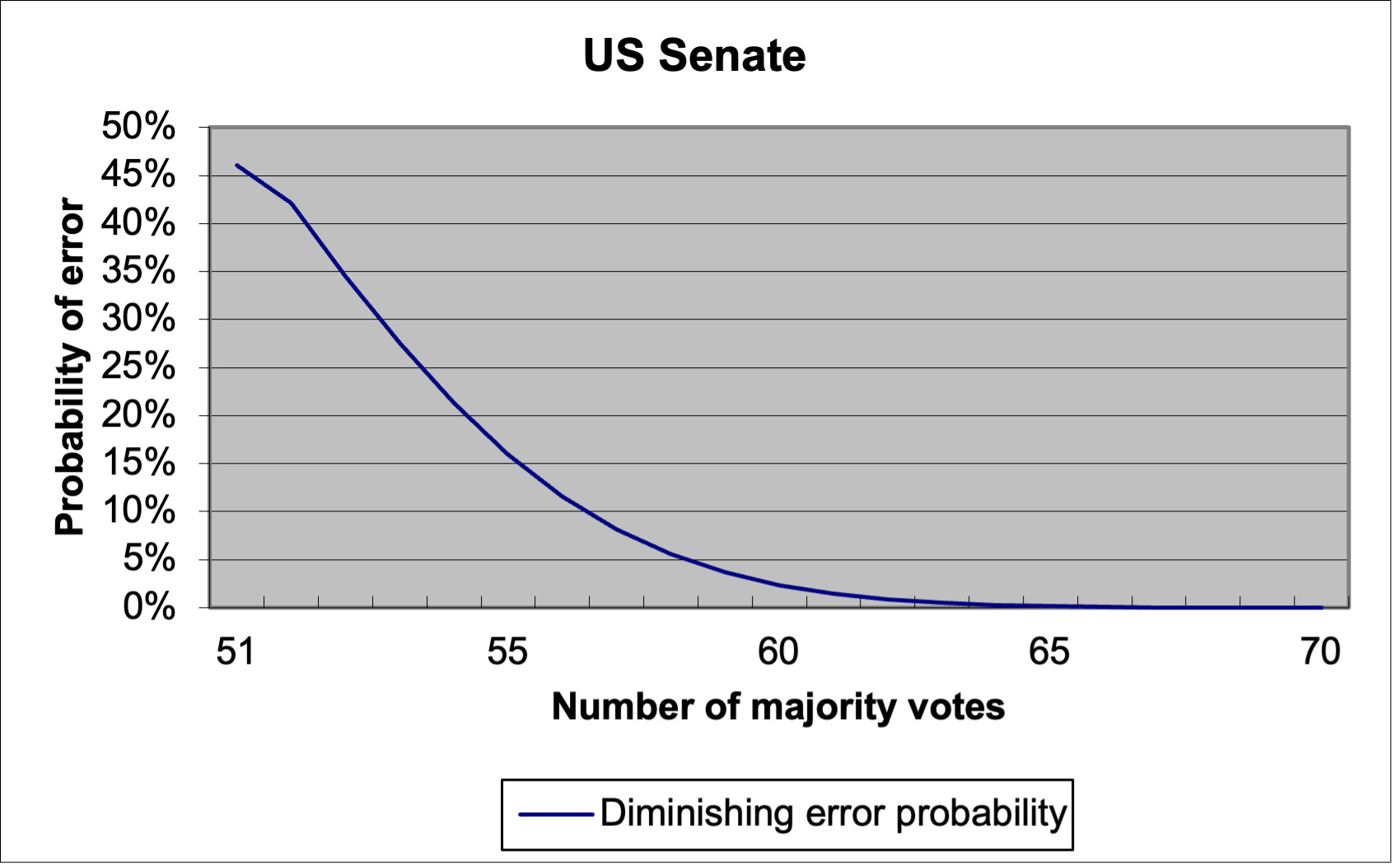
Figure 3 shows, as expected, error probabilities declining as the voting majority increases. The error probability is approximately 2 percent under the Senate’s sixty-vote filibuster convention, and falls virtually to zero when the majority reaches sixty-seven votes (two-thirds), which (perhaps coincidentally) is the Constitution’s smallest prescribed supermajority.
Similar error probabilities for House of Representatives voting (all 435 members) are depicted in figure 4.
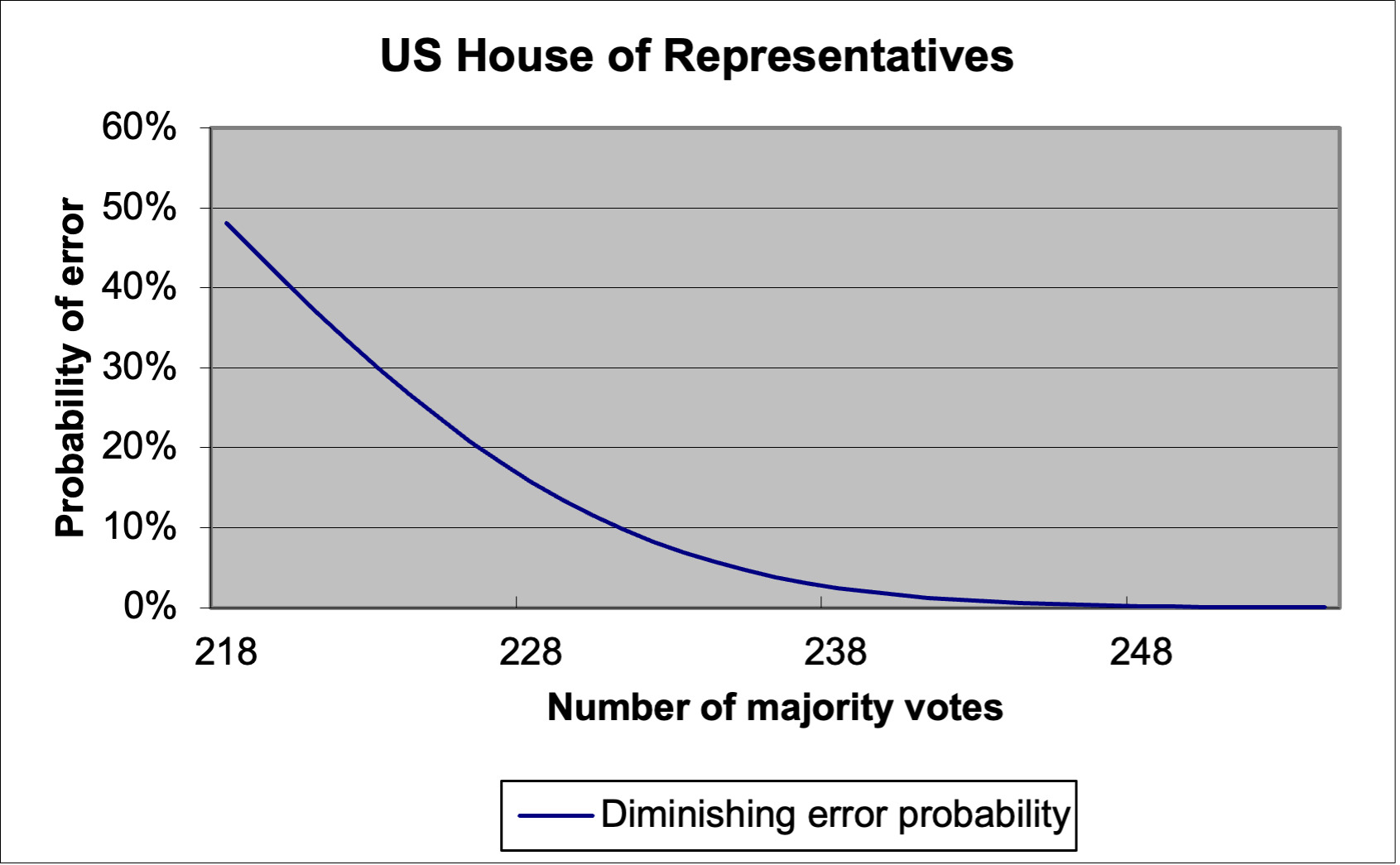
Like its predecessor, figure 4 shows error probabilities declining as voting majorities increase. Here, the probability is virtually zero when the majority vote reaches 248. It touches 2 percent at 239 votes, which is the House equivalent of the Senate’s sixty-vote filibuster convention.
A supermajority voting rule is publicly beneficial, both because it decreases the likelihood that erroneous public decisions stemming from ignorance and political mischief will become law and because it compels an additional measure of bipartisanship at the margin, and so would increase public trust and confidence in legislative choices when, as now, the democratic process is in disrepute. A voting rule specifying some minimum error probability for all legislative voting—say 2 percent (by way of comparison, 5 percent is the maximum allowable error for economics research; 1 percent or lower is demanded for higher-stakes medical research)—would impede advances by the open society’s enemies.
One plausible argument against supermajority voting is that it would obstruct the repeal of laws determined to be counterproductive. This objection is easily overcome through “sunset” provisions requiring all substantive legislation to either be reaffirmed periodically or else be repealed automatically; Obamacare subsidies are an example. Another contrary argument might be that presidential vetoes, coupled with congressional override provisions (requiring a two-thirds supermajority), provide an adequate defense against erroneous legislative decisions. However, this arrangement enables erroneous legislation that passes Congress by a simple majority to become law via a presidential signature. Erroneous legislation is better nipped in the bud.
The most telling argument against adopting a supermajority defense is the improbability that politicians would accept it, either as a formal rule or as a more robust constitutional amendment. The Senate’s filibuster convention presently exposes both the power of supermajority voting and its political weakness.
Conclusion
Mr. [Walter] Bagehot once remarked that it was no proof of the excellence of the Constitution of the United States that the Americans had operated it with conspicuous success because the Americans could run any constitution successfully; and, while the compliment is altogether acceptable, it is certainly true that our practical sense is more noticeable than our theoretical consistency, and that, while we were once all constitutional lawyers, we are in these latter days apt to be very impatient of literal and dogmatic interpretations of constitutional principle.
—Woodrow Wilson, Constitutional Government in the United States
Popper’s bare-bones conception of an open society constitutes a capacious vessel capable of simultaneously holding indefinitely many competing notions of nominally fair, effective, and efficient government. Wilson (1908, 57), echoing Bagehot, agreed that “the government of the United States has had a vital and normal organic growth and has proved itself eminently adapted to express the changing temper and purposes of the American people from age to age.” The referent here is America’s federalist Constitution, which Wilson disparaged as being rigidly Newtonian, and therefore outdated, in the modern age of flexible (i.e., progressive) Darwinist thinking (56–57). Wilson strongly preferred Britain’s unwritten constitution and parliamentary governing scheme, which he sought to emulate via dubiously constitutional progressive subversions.
Wilson proclaimed, in 1876, his doubt that a constitutional America could survive a second century of existence without progressive innovations (Pestritto 2005, 49–50, quoting Wilson). Many such innovations have been implemented since, and continue in force. And yet George Will (2019, xxxv) writes: “As America approaches the quarter-millennium mark it is neither cheerful nor content. Its discontents arise, in part, from the fact that for a century progressivism has been ascendant in the nation’s political thought and practices, a lingering malady of Wilson’s naive historicism and grandiose political aspirations. Many of the nation’s disappointments and difficulties stem from the resulting repudiation of the principles of the nation’s founding.” Will refers here to the classical liberal principles that underlie the truly open society.
Pestritto’s study of progressivism’s advance into the twenty-first century darkly concludes that “for a long time since the original [Wilsonian] Progressive era . . . two different regime ideas [America’s founding principles versus progressivism] have coexisted uneasily, but the divides of our own time indicate that we are reaching a point of decision, where we will not be able to continue for much longer with citizens of two different regimes occupying the same country. The progressives understood that in order to consummate the transformation they envisioned, the new regime would ultimately have to replace the original” (Pestritto 2021, 268; see also Sowell 2007). The conflict of visions between irreconcilable opposites has become a Manichean battle between good and evil, as judged differently by partisans on each side. Deneen (2018, 17) summarizes the present situation: “Our main political choices come down to which depersonalized mechanism will purportedly advance our freedom and security—the space of the market, which collects our billions upon billions of choices to provide for our wants and needs without demanding from us any specific thought or intention about the wants and needs of others [i.e., classical liberalism]; or the liberal state, which establishes depersonalized procedures and mechanisms for the wants and needs of others that remain insufficiently addressed by the market [i.e., progressive liberalism].”
The present article suggests that neither political alternative can produce in perpetuity the blissful existence of heaven on earth. At the national level, democracy propels open societies toward closure, revolution, and reset; already the current cycle has arguably passed through a formative cold civil war stage. America’s political parties and three branches of federal government are openly at war, not only between parties and among politicians themselves, but also against both private individuals and the people. This battle will continue until politicians settle into a form of liberalism that will prevail until American society ends in revolution and the socioeconomic-political cycle begins again, most likely along classical liberal lines.
Pestritto (2021, 243) reports that “for all its impact on national government, [progressive liberalism] has had much more immediate and radical effects on state and local government,” principally by augmenting liberal legislative and administrative processes with traces of direct democracy. These measures include ballot initiatives, recall petitions, referendums, and primary elections. State constitutions are easily amended by simple majority votes, and so easily accommodate changing political visions. One irony is that direct democracy is the antithesis of Wilsonian liberalism, which sought to make democratic institutions more democratic but also less important. Another irony is that studies reveal direct democracy as “the principle means by which interest groups have altered the balance of power within states. . . . The sums spent on initiatives in recent decades have come to dwarf spending on races for state political office” (Smith and Tolbert 2004, 88–89).
Progressive state and local governments have become increasingly collectivist, broadly implementing paternalistic social policies and maternalistic social programs, both of which are often funded by misguided federal grants. The essential distinction between federal and state action is this: “Congress possesses only the authority that the Constitution grants it, unlike state governments, which possess any authority that the Constitution does not deny them” (Barrett 2025, 163). This dichotomy augurs poorly for America remaining as a nominally open society.