The main purpose of this article is to present a climate change policy based on Rothbardian property rights and tort litigation. The argument is that the Intergovernmental Panel on Climate Change (IPCC) and net zero by 2050 legislation have created a tort and that tort litigation should therefore be brought against them. Developments in climate science give this argument greater support than was available for earlier articles (Dawson 2008; 2009; 2011; 2012). The central principle of a Rothbardian climate policy is that environmental problems do not arise from externalities caused by market failure, as understood in neoclassical economics, but from interpersonal conflicts caused by an incomplete allocation of property rights. Mises ([1949] 2007), Anderson and Leal (1991), Cordato (2004), and Pennington (2005; 2010) have analyzed environmental issues within a property rights paradigm shared with Rothbard (1990). The Rothbardian perspective on climate policy can be understood as a contribution to free market environmentalism, robust political economy, and robust decision-making.[1] This article reviews the arguments advanced elsewhere (Dawson 2008; 2009; 2011; 2012) in light of recent developments in climate science. From the Rothbardian perspective, which stipulates proof of causality beyond a reasonable doubt, the commitment to net zero by 2050 should be rejected. The knowledge base for net zero by 2050 is insecure because it relies solely on the uncertain predictions of climate models and the imperfectly designed procedures of the IPCC. In this application of Rothbardian welfare economics, tort litigation should be used against the IPCC on the grounds that the IPCC is in breach of its duty to provide reliable scientific advice to policymakers taking part in the conference of the parties (COP) process. A class action bringing a tort against the IPCC on these grounds would allow dissident climate scientists to be called as expert witnesses, thereby extending the scope of substantive freedom of expression. The principle of freedom of expression is effectively denied by the procedures of the IPCC because the IPCC’s policy recommendations are the outcome of a process of synthesizing numerous research results into a consensus. This offends against substantive freedom of expression: Scientists are formally free to research and publish their findings, in the sense that there is no law prohibiting them from doing so, but they are prevented from exercising this freedom because they lack the dissemination resources and official recognition of the IPCC.
Rothbardian Environmental Policy
In neoclassical economics, pollution is understood as a market failure because the costs of production do not include external costs, those borne by economic agents other than the producer and the consumer. The market transaction therefore fails to maximize social welfare. To correct this market failure, Pigou (1920) advocated a tax on the production or consumption of the good, set at a level that would reduce its consumption sufficiently to bring into equilibrium the contribution to social welfare produced by the good and the reduction in social welfare caused by pollution. The application of such a Pigouvian tax to a particular case of market failure faces substantial problems of uncertainty in estimating, in monetary terms, the external costs and benefits of production and consumption. These issues are particularly daunting in the case of climate change, where the alleged externality is global in scope and stretches over centuries. Strenuous pioneering efforts by Stern (2007) and Nordhaus (2007) illustrate these problems (Dawson 2008). The first challenge is to forecast the future course of climate change. The uncertainty surrounding such forecasts is the subject of the sections on climate models and Rothbardian climate policy.
A Pigouvian tax entails government intervention in economic activity, albeit market-based rather than regulatory intervention. Coase (2013) employed the concepts of property rights and transaction costs to argue that the problem of externalities could be solved without government intervention. The Coase theorem states that if the property rights of the polluter and the victim are clearly defined and information and transaction costs are low, market agents can engage in voluntary bargaining to reach a Pareto-efficient outcome, so that neither polluter nor victim could be made better off without making the other worse off. In practice, inequalities in bargaining power, a lack of clearly defined property rights, and significant transaction costs may impede the attainment of such an outcome.
Property rights are a central principle of free market environmentalism (FME). Anderson and Leal (1991) argued that government intervention in markets to solve environmental problems is unnecessary if property rights are clearly defined and enforceable and voluntary transactions take place in competitive markets under the protection of the rule of law. Adler (2009) has discussed the application of this paradigm to climate change.
The foundational principle of property rights in Rothbardian environmental policy is first use or homesteading (Rothbard 1990). A polluter has the right to dispose of wastes in unused airspace; someone who later “comes to the nuisance” by buying land near a source of local air pollution has no valid claim to redress. Equally, a farmer has a right to grow crops on land free from aggressive actions by fossil fuel users which cause rising sea levels to flood the farmer’s land and is therefore entitled to redress. It is also true that a fossil fuel user has a right to continue to emit CO2 if an authority forbids further emissions on grounds that are inadequately supported by evidence.
From the perspective of Rothbardian property rights theory, climate change is an interpersonal conflict over the use of the atmosphere. Individuals, firms, and state organizations working with energy derived from fossil fuels use the atmosphere as a carbon sink and may thereby alter the climate in ways that interfere with the activities of other agents which need an unchanged climate to grow crops, rear animals, and inhabit land only marginally above sea level. In a world guided by a Rothbardian perspective, the monopoly power of the IPCC would not be deployed to curtail economic activity to achieve net zero by 2050. Economic activity in general would be subject to side constraints aimed at preventing harm to others, as Nozick (1974) suggested, building on the foundation of the Kantian principle of respect for persons. This is the second formulation of Kant’s categorical imperative, which stipulates that the autonomous rational agent must respect the autonomy and rationality of other autonomous rational agents, thereby treating individuals as ends in themselves who must not be used merely as means. Litigation initiated by individuals, firms, or groups to seek redress of grievances potentially caused by greenhouse gas (GHG) emissions breaching side constraints would be decided in the courts on the basis of testimony by a wide range of expert witnesses, including climate scientists excluded from IPCC deliberations. The issue to be decided is whether atmospheric concentrations of CO2 cause climate change.
If property rights are adequately assigned, the next question is whether a person’s property rights have been infringed. This is an empirical question of whether one agent’s actions have damaged another’s property. There are two aspects to the issue of causality in the Rothbardian approach to climate change. The principle of strict liability and the law of nuisance focus on causality (Hoppe 2004; Cordato 2004; Morris 2008), in this case whether the human use of fossil fuels causes global warming. First, the epistemic status of the putative facts of the case must be clarified. Rothbard (1990, 245) states a clear principle: “To establish guilt and liability, strict causality of aggression leading to harm must meet the rigid test of proof beyond reasonable doubt. Hunch, conjecture, plausibility, even mere probability, are not enough. In recent years, statistical correlation has been commonly used, but it cannot establish causation.” Second, it is important to clarify the extent of a property owner’s rights. Rothbard (256) makes the point that “no one has a right to clean air, but one does have a right not to have his air invaded by pollutants generated by an aggressor.”
A Rothbardian climate policy indicates a route to a possible solution which does not rely on government intervention and does not require bargaining between private individuals (Rothbard 1990; see also Mises [1949] 2007; Cordato 2004). The subject of economic inquiry is purposeful behavior rather than resource allocation. A focus on resource allocation overlooks the original cause of an environmental problem in a conflict between purposeful individuals over the use of resources. The solution is for the victim of pollution to bring a civil action against the polluter on the grounds that the polluter has committed a civil wrong, or tort, against the victim, with the intention of securing compensation for the harm suffered. National and international legislation to limit CO2 emissions and thereby curtail the putative adverse effects of climate change is already in place, making private torts against CO2 emitters unnecessary. Climate change legislation itself may give rise to a tort if it prevents producers and users of CO2 from pursuing profitable enterprise on the basis of unwarranted claims about the effects of their actions. In this case, a class action by fossil fuel producers and consumers would challenge the dominant position of the IPCC.
The IPCC’s version of climate history shows a flat global temperature record until 1880, when a sharp rise begins. In the section on the IPCC, climate science, and climate history, this claim will be tested against evidence of four climate anomalies in the last two thousand years that were not linked to the burning of fossil fuels. In the section on the IPCC and climate models, decisions about solar irradiance, volcanic forcing, natural variability, model calibration, and climate sensitivity, all of which determine the parameters of climate models, will be critically examined. The size of the impact of each of these factors is uncertain and contentious, with research producing a range of estimates. What are the prospects of establishing causality and hence liability? This issue is considered in the section on Rothbardian climate policy.
The IPCC, Climate Science, and Climate History
This section contains a critical discussion of the IPCC’s procedures and results. If we take scientific method to consist in conjecture and refutation, the IPCC’s aim of reaching a consensus, in part by excluding dissident views, risks inadequate testing of hypotheses. Climate science, as expounded by the IPCC, is therefore a problematic basis for climate policy. The IPCC’s position as monopoly supplier of climate science to national governments has given unwarranted credibility to two claims: Recent global warming is almost entirely anthropogenic, and the rate of increase constitutes a climate emergency.
Conjecture and Refutation Versus Consensus
The IPCC was established in 1988 by the World Meteorological Organization (WMO) and the United Nations Environment Programme (UNEP) to make regular assessments of the science of climate change. IPCC assessments inform negotiations at COPs, where world leaders attempt to reach a consensus on the causes of climate change, its impacts, and policy responses. The IPCC (2023) claims to be “a unique interface between science and policy. Because of its scientific and intergovernmental nature, its assessments provide rigorous and balanced scientific information to decision-makers.” This arrangement confers on the IPCC an effective monopoly in the provision of climate science to the COP process.
Rothbard relies on the principle that, to be successful, a claim that a carbon emitter has infringed the property rights of a plaintiff must be found to be true beyond a reasonable doubt. This might seem out of place in any empirical science, where there is always room for doubt. Rothbard’s principle is, however, of the greatest possible relevance to the critical scrutiny of the officially accepted version of climate science, for two reasons. First, the central verdict of the IPCC’s (2021a, 4) Sixth Assessment Report (AR6) is that “human activities, principally through emissions of greenhouse gases, have unequivocally caused global warming, with global surface temperature reaching 1.1°C above 1850–1900 in 2011–20. Global greenhouse gas emissions have continued to increase, with unequal historical and ongoing contributions arising from unsustainable energy use, land use and land-use change, lifestyles and patterns of consumption and production across regions, between and within countries, and among individuals (high confidence).” The claim that human activities have unequivocally caused global warming is a strong one, implying that there is no doubt about the cause of global warming, which is an even stronger claim than “beyond a reasonable doubt.” It is also worth noting the enormity of the changes to so many aspects of life that the IPCC is implicitly calling for, which can be warranted only if its verdict on causation really is true beyond a reasonable doubt. Second, the scale of the changes to production and consumption that are implicit in the IPCC’s assessment is justified only if it is indeed beyond a reasonable doubt that human activities have caused global warming. Is the IPCC’s confidence justified?
The case against the IPCC exposes the gap between its claim to scientific credibility and its antiscientific procedures, which prevent its findings from being beyond a reasonable doubt. According to Popper (1965, 24–25), scientific research is a process of conjecture and refutation, with conjectures that fail to withstand empirical testing provisionally refuted and those that have so far survived empirical testing provisionally accepted. Many scientists researching different aspects of the climate, such as natural variability, climate sensitivity, and solar irradiance, work in an authentically Popperian scientific environment of “friendly-hostile cooperation,” as Popper (1965) put it. A disinterested review of the research produced in such a Popperian world would not yield a solid foundation for a decisive plan of action but would instead issue a noncommittal or open verdict on each of these aspects of climate change.
This is far removed from the procedures of the IPCC: “In its most recent assessment, IPCC states unequivocally that the consensus of scientific opinion is that Earth’s climate is being affected by human activities: ‘Human activities . . . are modifying the concentration of atmospheric constituents . . . that absorb or scatter radiant energy. . . . Most of the observed warming over the last 50 years is likely to have been due to the increase in greenhouse gas concentrations’” (McCarthy 2001, 21). In its latest assessment reports, the IPCC (2023) continues to prioritize “where there is agreement in the scientific community. . . . Through its assessments, the IPCC determines the state of knowledge on climate change. It identifies where there is agreement in the scientific community on topics related to climate change, and where further research is needed. The reports are drafted and reviewed in several stages, thus guaranteeing objectivity and transparency. The IPCC does not conduct its own research. IPCC reports are neutral.”
There are several difficulties with these statements. First, the selection of contributors excludes researchers with skeptical or dissident views; for example, the contributors to The Frozen Climate Views of the IPCC: An Analysis of AR6 are overlooked. Second, the contributors include activists and other nonacademic sources. In reviewing an audit of IPCC contributors conducted by Laframboise (2011), Ridley (2011) reports that it “showed that 5,587 of 18,531—fully one-third—were non-peer-reviewed sources: including newspaper articles, activist reports, even press releases.”
Third, it will be noted in the section on the IPCC and climate models that AR6 relies on climate models informed by assumptions that consistently tend toward diminishing three nonanthropogenic forces: natural variability, climate sensitivity, and solar irradiance (Curry 2023a, 99–104, app. B). The result of treating contentious issues as if they had been settled is an enhanced role for anthropogenic warming. Fourth, the Independent Summary for Policymakers of IPCC AR4 is not a purely scientific document but rather “the product of political bargaining among member governments” (Kaspar 2007, 90; McKitrick et al. 2007).
The consensus that the IPCC has artificially constructed and imposed might in time give way to something much closer to the “friendly-hostile competition” of the Popperian ideal. The bipartisan structure of the public debate on climate change, in which a unified climate change establishment presents itself as confronted by a tiny minority of wild deniers and eccentric skeptics, would be transformed to include the full range of reasonable positions including reasonable skepticism on many aspects of climate change. Such a development could only advance climate science. Grossman (2003, 4) refers to “the lack of public knowledge about climate change, caused by the evolving and complicated science of climate change and compounded by some fossil fuel companies’ efforts to encourage public uncertainty and inaction on global warming.” On the contrary, in a world where the IPCC has used its monopoly power in the dissemination of climate science to legitimize intemperate and damaging policy intervention, more should be done to communicate the uncertainties that are inescapable in climate modeling. The reasonableness of rival theories postulating natural forcing might be more widely understood if climate change tort litigation were to provoke the publication of testimony from a range of expert witnesses.
Anthropogenic and Natural Warming
The IPCC (2023, 4, fig. 2.1) claims that anthropogenic warming is responsible for almost all the global surface temperature increase since 1850: “The likely range of total human-caused global surface temperature increase from 1850–1900 to 2010–2019 is 0.8°C to 1.3°C, with a best estimate of 1.07°C. Over this period, it is likely that well-mixed greenhouse gases (GHGs) contributed a warming of 1.0°C to 2.0°C, and other human drivers (principally aerosols) contributed a cooling of 0.0°C to 0.8°C, natural (solar and volcanic) drivers changed global surface temperature by –0.1°C to +0.1°C, and internal variability changed it by –0.2°C to +0.2°C” (IPCC 2023, fig. 2.1). However, these predictions cannot be regarded as beyond a reasonable doubt because climate science is a problematic foundation for climate policy, as argued in previous articles (Dawson 2008; 2009; 2011; 2012). The central argument of those previous articles remains valid: The IPCC should be challenged as a knowledge monopoly for the COP process and existing climate change legislation, including net zero by 2050, should be rescinded and replaced with tort litigation to establish whether strict liability exists. This would advance climate science by appeal to expert witnesses for and against the anthropogenic climate change thesis. In this section, it is argued that climate science does indeed remain a problematic foundation for climate policy. The monopoly position of the IPCC with respect to the COP process is clearly secure, but the costs and impracticality of net zero by 2050 may ultimately lead to its collapse and to an examination of the IPCC’s responsibility for this debacle. It is therefore far from clear that this article is an elegy for the road not taken to a rational climate policy.
Those who believe that there is a climate emergency usually claim that “the science is settled.” What is settled is that global mean surface temperatures have increased since 1880, that the use of fossil fuels in economic activity increases atmospheric concentrations of CO2, and that CO2 and other GHGs have a warming effect on the planet (Curry 2023b). This, however, leaves crucial questions that are not settled beyond a reasonable doubt. Dissenting scientists mount a genuine scientific challenge to the IPCC consensus by questioning (a) whether all recent warming is anthropogenic rather than in part the product of solar and volcanic drivers and internal variability in the climate system, (b) the rate at which the planet is warming and whether this amounts to an emergency, and (c) whether the optimal policy response is mitigation by seeking to reduce CO2 emissions to net zero by 2050 (Crok and May 2023; Curry 2023a).[2]
The IPCC (2023, 8) is in no doubt about whether all recent warming is anthropogenic, stating that “human activities, principally through emissions of GHGs, have unequivocally caused global warming, with global surface temperature reaching 1.1°C above 1850–1900 in 2011–2020.” Nonanthropogenic forces are the natural variability of the climate system, driven largely by changes in ocean currents, and external factors, which are changes in solar and volcanic activity. IPCC (2021a, fig. 2.2.1, FAQ 3.2) authors believe that these are insignificant. The “influence of natural variability is typically small when considering trends over periods of multiple decades or longer. When estimated over the entire historical period (1850–2020), the contribution of natural variability to global surface warming of –0.23°C to +0.23°C is small compared to the warming of about 1.1°C observed during the same period, which has been almost entirely attributed to the human influence.” The IPCC concludes that variability in solar activity over the past century and millennia was much too small to affect climate in a significant way. The implication of these findings is that, in the hypothetical absence of increases in atmospheric concentrations of GHGs arising from fossil fuel use, there would have been no significant global warming.
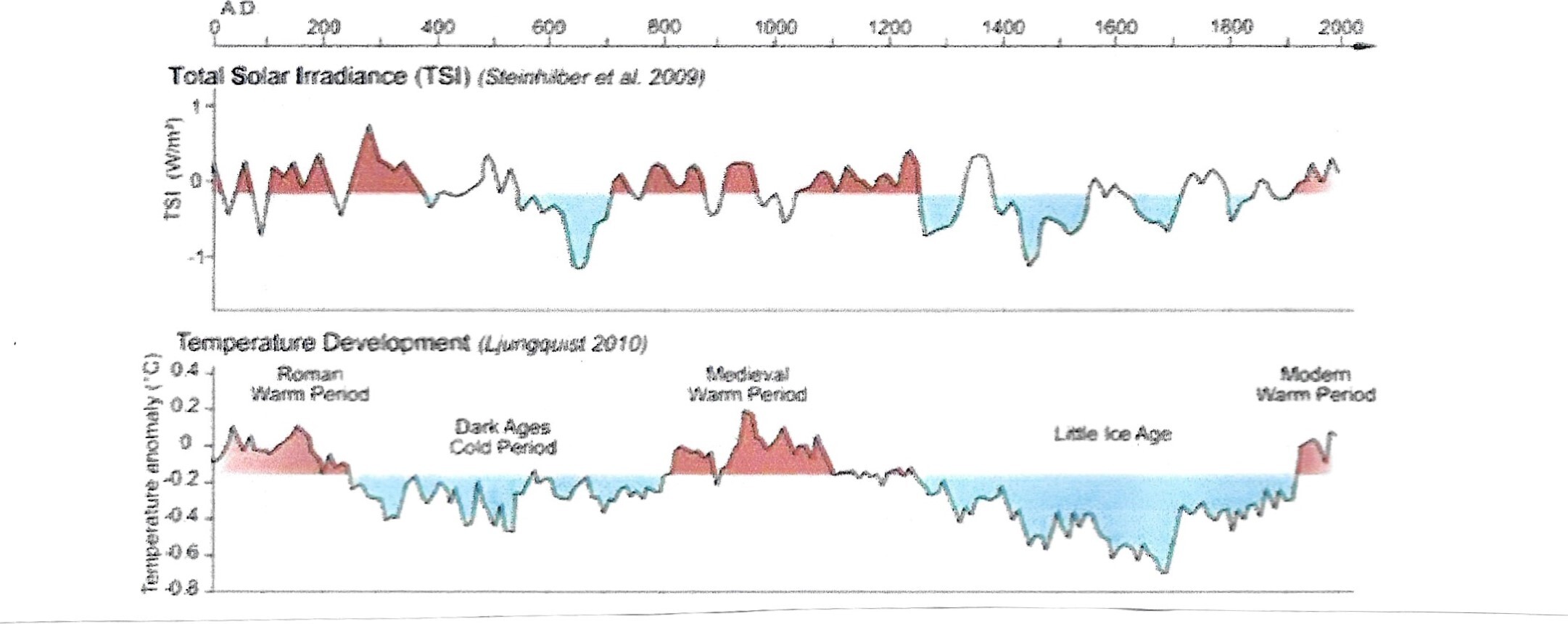
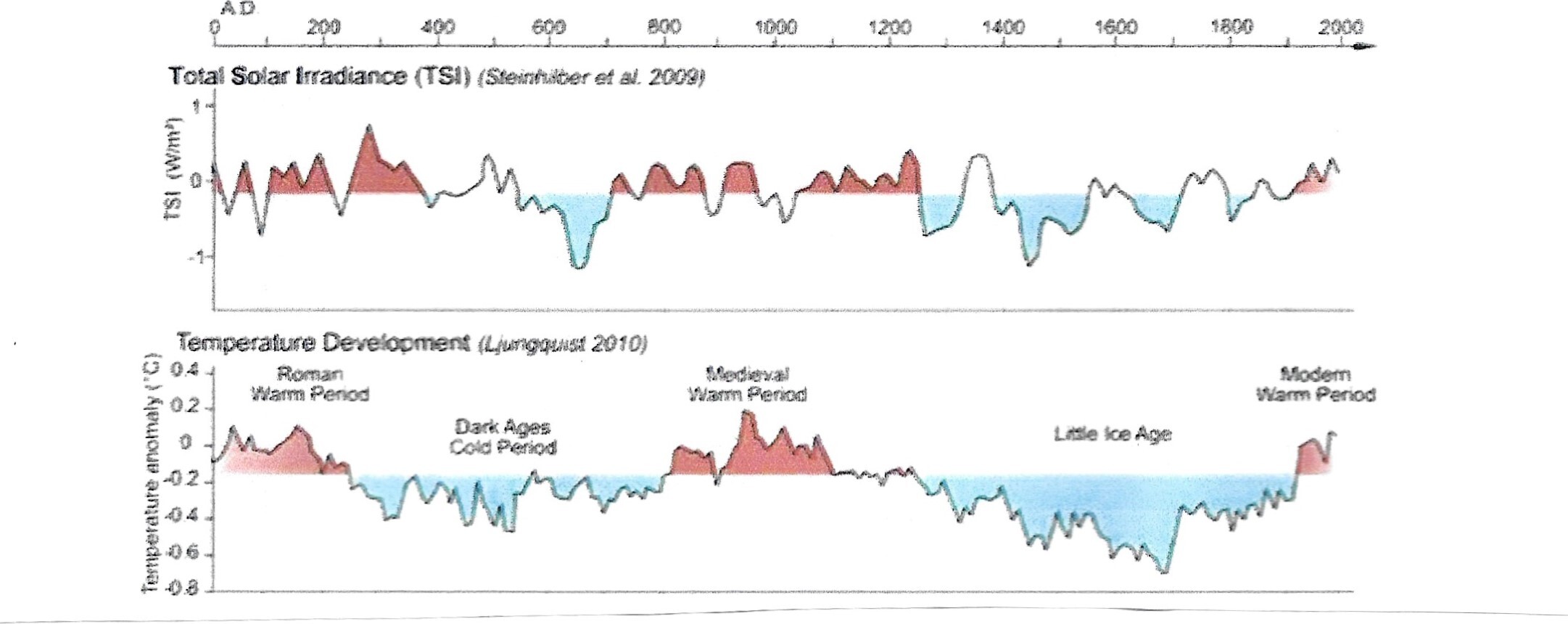
The IPCC position is based on a multiproxy temperature reconstruction using data from tree rings, ice cores, and lake sediments. Figure 1 shows the five historical eras during which global temperatures have been unusually warm or cold: the Holocene Thermal Maximum (previously the Holocene Climate Optimum), the Roman Climate Optimum, the Medieval Warm Period, the Little Ice Age, and the Modern Warm Period (see Mannheimer 2022, fig. 12). The IPCC (2021a, fig. 1) denies that the first four ever happened; their reconstruction of global surface temperatures suggests that current levels are probably unprecedented in the past 125,000 years. Frankopan (2023, 624) is convinced by the AR6 version of climate history, which shows a flat global temperature record until 1880, when a sharp rise begins. The first four climate anomalies “were not universal, but rather were particularly pronounced in one or more regions, and even on one or more continents.” Since the 1880s, by contrast, there has been a “globally coherent pattern of warming” and for “98 percent of the planet, the twentieth century was the warmest period of the last two millennia.”
There are two lines of critique against the IPCC claim that current temperatures are unprecedented: The first four climate anomalies cannot be dismissed as merely regional, and the Modern Warm Period is no more coherent than previous ones. Since it is obviously impossible to measure temperatures in the distant past directly, biological features associated with different temperature regimes are used as proxies to reconstruct historical temperatures. There are, however, many uncertainties surrounding proxies; for example, changes in tree rings may be influenced by precipitation as well as temperature. Combining proxies to produce an average score depends on decisions by researchers, and an outlier reading from one location may bias the average (Vinós 2023, 22–24). Subject to such uncertainties, it is possible to reconstruct the past extent of glaciers and treelines, the maximum altitude at which trees can grow. The limit of glaciation was most reduced during the Holocene Thermal Maximum, and Northern Hemisphere treelines were much higher during that time (Vinós 2023, 25–27). Frankopan (2023, 64–65) cites evidence for changes in agriculture associated with warmer temperatures across eastern China, the Sahara, which became grass savannah, Guatemala, the Levant, Anatolia, Egypt, and the Americas. It is reasonable to conclude that, although it was “not a time of uniformly warm temperatures . . . most parts of the globe were warmer during some part of the Holocene Thermal Maximum than now” (Vinós 2023, 23–24).
The first three climate anomalies of the last two millennia are dismissed in AR6 by rehabilitating the so-called hockey stick, which displays a supposedly flat temperature record (the shaft) until the sharp upturn (the blade) of the Modern Warm Period. The IPCC’s Third Assessment Report (2001) drew on Mann (1999), which first represented the temperatures of the last two thousand years as resembling a hockey stick, but this was severely criticized for deficiencies in the use of proxies and in statistical analysis (McIntyre and McKitrick 2005; Montford 2010).[3] Frankopan’s (2023, 209) encyclopedic survey of climate history reports evidence of temperature and climate variability corresponding to the second, third, and fourth anomalies, observing the “unusually high levels of solar irradiance that were . . . responsible for the Roman Climate Optimum.” After quoting Lamb (1965) on the “notably warm climate in many parts of the world during the Medieval Climate Anomaly” (Frankopan 2023, 257), he concludes that there had been “a major global climate reorganisation” (258) with reduced volcanic activity and changes in the internal variability of the climate system. Again, high levels of solar irradiance were associated with this “global climate reorganisation.” Conversely, low levels of solar activity are associated with lower temperatures. According to Scafetta and Vahrenholt (2023, 83), the “Little Ice Age (1300–1850) was one of the coldest periods of the last 10,000 years. Solar activity was at a very low level, a level only rarely seen in the last ten millennia. Is this really just a coincidence?”
These findings raise serious doubts about the IPCC claims reported at the beginning of this section: Global warming since 1880 is almost entirely the consequence of fossil fuel use, and solar variability was much too small to influence the global climate. It has not been established that global surface temperatures over the last two thousand years were stable until 1850; it seems undeniable that warm and cold periods occurred and were extensive at more than a merely regional level. Although he does not want to downplay “potentially catastrophic global warming in the course of the twenty-first century,” Frankopan (2023, 60) points out that “current projected rises of 1.5°–2.0° . . . look paltry indeed compared to the very many and regular double-digit rises and falls that have occurred in the past.”
The IPCC is equally confident of its answer to the question of the rate at which the planet is warming and whether this amounts to an emergency. Frankopan (2023, 624) argues in effect that the blade of the hockey stick reflects the increase in global temperatures of the Modern Warm Period and that “the decade 2010–20 was the warmest since modern record-keeping began in the 1880s.” Moreover, this increase is “part of a globally coherent pattern of warming,” unlike previous warm periods, which were “particularly pronounced in one or more regions.” There are two dimensions, temporal and spatial, along which recent temperature increases fail to be “globally coherent.” First, the 1930s were the warmest decade until the 1990s even though atmospheric concentrations of CO2 were too low to have had any explanatory power; as they increased during the 1950s and 1960s, temperatures fell, rising during the 1980s and 1990s until the hiatus of 1998 to 2015. Second, the rate at which temperatures are rising is far from uniform, with those in polar regions increasing at four times the rate of those in the tropics. These observations suggest that the sharp distinction which Frankopan wishes to draw between the supposedly merely regional warm periods before the twentieth century and the “globally coherent” Modern Warm Period is of questionable validity.
The IPCC and Climate Models
A deeper insight into the rate at which the planet is likely to warm in the twenty-first century can be found by comparing empirical observations of temperature increases with the predictions of climate models. This is not a simple task because climate models yield a range of predictions, and different methods of measuring temperatures also produce a range of results. Bailey (2023) reports that “the latest suite of climate models collectively project that the average temperature of the global atmosphere should be increasing at the rate of about 0.28–0.29 degrees Celsius per decade.” Measurements of surface temperatures recorded by weather stations, oceangoing ships, and buoys and collected by several international organizations indicate that the global temperature is increasing at a rate of 0.18°C to 0.19°C per decade. Satellite measurements of temperature trends in the troposphere have been available since 1978 and show an increase of 0.13°C to 0.18°C per decade.[4] Bailey (2023) concludes that “all of the surface and satellite trends are considerably lower than the average of the projections made by the most recent set of climate models.” Scafetta (2021) has also compared temperature predictions from climate models with temperature observations.
Once again, it seems that most of the temperature predictions from climate models are higher than terrestrial and satellite temperature observations. The question that arises is whether the IPCC is justified in privileging model predictions over observations.
In the Fourth Assessment Report (AR4), the IPCC (2007, title page) presented its work on impacts, adaptation, and vulnerability as the “standard scientific reference for all those concerned with the consequences of climate change.” Yet Dawson (2009, 60) notes that, on “the IPCC’s own admission, it is impossible to say whether the impact of climate change will be mild or catastrophic.” The IPCC developed six scenarios, or descriptions of possible outcomes for global temperatures in 2100, ranging from 1.5°C above the baseline period 1850–1900 to 4°C. The IPCC, however, found that no probability can be attached to the scenarios. It was concluded that “where there is no possibility of estimating probability or risk, there is radical uncertainty” (Dawson 2009, 60). It is therefore radically uncertain whether the effects of global warming in 2100 will be mild at 1.5°C or catastrophic at 4°C above baseline.
How have things changed? In 2018, the IPCC (2018) published Global Warming of 1.5°C, which used an extreme scenario, RCP8.5,[5] to argue that global temperatures should be limited to 1.5°C above baseline 1850–1900 or preindustrial temperatures. There was no room for uncertainty here, and for a while this became the standard scientific reference guiding policymakers and the media, not least because it was misleadingly presented as “business as usual” and projected a global temperature of 5°C above baseline by 2100. But the plausibility of RCP8.5 soon collapsed under criticism pointing out that it required “up to 6.5 times more coal use in 2100 than today—an amount larger than some estimates of economically recoverable coal reserves” (Curry 2023a, 84).
AR6 presents the scenarios as shared socioeconomic pathways (SSPs), recognizing that future temperatures depend on policy responses shaped by socioeconomic forces as well as the physical basis of the climate system. The conclusion is unchanged from AR4 (IPCC 2007), which was quoted in Dawson (2009): “In general, no likelihood is attached to the scenarios assessed in this Report (IPCC 2021a, 1.6.1.4),” implying that the discredited extreme scenario, now SSP5-8.5, is still worth serious consideration by policymakers. Nevertheless, it is possible to evaluate the scenarios by examining decisions about solar irradiance, volcanic forcing, natural variability, model calibration, and climate sensitivity, which determine the parameters of climate models, as well as socioeconomic factors. The size of the impact of each of these factors is uncertain and contentious, with research producing a range of estimates. A reasonable person would input average or moderate estimates into such models, but, as Curry (2023a, 99–104) demonstrates, AR6 uses climate models based on assumptions that consistently tend toward diminishing the three nonanthropogenic forces. Climate modelers treat these contentious issues as if they had been settled in favor of an enhanced role for anthropogenic warming.
There are good reasons for believing that nonanthropogenic forces continue to have significant effects on global temperatures. First, it was suggested in the previous section that solar variability has significantly affected global temperatures over decades and centuries, although solar scientists disagree about the size of this effect. Connolly et al. (2021) conclude their thorough exploration of the literature on how much the sun has influenced Northern Hemisphere temperature trends by describing the question as an ongoing debate:[6] “We argue that the Sun/climate debate is one of those issues where the IPCC’s ‘consensus’ statements have been prematurely achieved through the suppression of dissenting scientific opinions.” There is no sign of that debate or of dissenting scientific opinions in AR6, a damaging omission and a questionable reliance on the modeling that produces the “shaft” of the hockey stick in the face of empirical evidence against it (see “A Rothbardian Climate Policy”).[7] Moreover, solar “activity reached unusually high levels in the second half of the twentieth century, estimated to be the highest in the last 8,000 years,” which is projected to be followed by low solar activity from 2002 to 2004 and lasting until between 2063 and 2075. Either way, the “next 20–30 years of observations should reveal a lot about the role of the Sun in climate” (Curry 2023a, 103–4).
Second, the natural internal variability of the climate system is driven over multidecadal cycles by ocean currents, of which the Atlantic multidecadal oscillation (AMO) is the most significant. The AMO shifts between warming and cooling phases every thirty years or so and entered a warming phase in 1995; it is therefore expected to shift to a cooling phase between 2026 and 2032 (Curry 2023a, 99–100).
Third, volcanic activity depressed global mean surface temperatures during the first half of the nineteenth century, when eruptions caused aerosol particles to reduce solar irradiance. Eruptions are unpredictable, and the IPCC therefore does not include an estimate of their possible effects on present or future temperatures, which in itself is not unreasonable. However, the eruption of the submarine volcano Hunga Tonga-Hunga Haʻapai in the South Pacific on January 15, 2022, injected an unprecedented amount of vaporized water into the stratosphere, increasing the quantity of water vapor in the atmosphere by 10 percent. It “may take several years for the H2O plume to dissipate. This eruption could impact climate . . . through surface warming due to the radiative forcing from the excess stratospheric H2O” (Millán et al. 2022).[8]
The technical issues of model calibration and equilibrium climate sensitivity are discussed in the appendix.
A Rothbardian Climate Policy
In this section, Rothbard’s environmental economics will be applied to climate change, which is seen as the outcome of interpersonal conflicts over the use of the atmosphere. Rothbard advocates tort litigation to resolve such conflicts, and in fact class actions have been brought against firms emitting carbon dioxide. The approach put forward here would instead charge the IPCC with being in breach of its duty to provide reliable knowledge about climate change to national governments and other actors. Skepticism of the IPCC’s confidence in claiming that climate change is anthropogenic and constitutes a climate emergency implies that a robust policy should be directed toward adaptation rather than mitigation.
The Use of Tort Litigation by Climate Activists and Freedom of Speech
The application of a Rothbardian policy framework to climate change is not an argument against the green energy transition as such but a critique of the scientific foundations of net zero by 2050. There are good reasons for transitioning from fossil fuels to renewables; in the 1970s, the original reason was that fossil fuels are a finite resource, and they remain so. It is also true that in tropical and midlatitude countries solar power is reliable and cheap, with consumers in Pakistan, for instance, going off grid with solar panels on rooftops. This is the market as a discovery procedure, and it does not need government regulations, targets, or subsidies to work. Net zero by 2050, on the other hand, sees governments driving the energy transition at a pace which (a) imposes unreasonable costs on firms and consumers and (b) is justified only if it is beyond a reasonable doubt that anthropogenic climate change is an imminent catastrophe. The argument advanced here is that there is no scientific justification for net zero by 2050, for the reasons set out in the sections on climate models and Rothbardian climate policy. The market as a discovery procedure can be expected to drive the energy transition as nuclear power eventually supersedes fossil fuels and wind and solar power.
What is the role of tort litigation under a Rothbardian climate policy in these circumstances? A Rothbardian approach sees climate change as an interpersonal conflict over the use of the atmosphere. Agents using energy derived from fossil fuels may alter the climate in ways that interfere with the activities of other agents who rely on an unchanged climate for their economic activities. The plaintiff may use tort litigation to seek compensation from the emitter or an injunction obliging the emitter to desist. The principle of strict liability focuses on causality and the law of nuisance. However, a plaintiff does not need to have recourse to tort litigation to seek to establish nuisance from the use of fossil fuels, because laws and international treaties are already in place that are based on the assumption that the question of causality has been settled.
There is already extensive recourse to litigation in climate change disputes, but the cases brought so far seem to overlook the question whether the IPCC reports are reliable and are intended merely to ensure that national governments abide by their commitments to reduce GHG emissions agreed at UN Climate Conferences such as 2023’s COP28. Columbia Law School maintains US and global climate change litigation databases recording hundreds of cases against national governments, corporations, and individuals, 230 of which concern non-US governments’ CO2 emissions reduction and trading policies. For example, in 2015 the environmental nonprofit organization Urgenda brought the first climate case in the world, which established that the Dutch government had “a legal duty to prevent dangerous climate change” (Urgenda, n.d.). The environmental law charity ClientEarth (n.d.) aims to “use the power of the law to drive transformational change—creating, strengthening and enforcing the right rules to support a healthy planet where nature and people can thrive together.” On May 3, 2024, ClientEarth, with Friends of the Earth and Good Law Project, won a High Court case against the UK government on the grounds that the government’s climate change strategy was in breach of the UK Climate Change Act because it “relies on high-risk and unproven technologies to tackle climate change, as well as vague and uncertain promises” (ClientEarth 2024). Such cases seem to take the predictions of the IPCC and the so-called scientific consensus associated with it as if they were established facts and focus on the question whether national governments and corporations are complying with the requirements of the COP process.[9]
The first reason for challenging this consensus is that it is an obstacle to substantive freedom of expression. John Stuart Mill ([1859] 2006, 23) enunciated the definitive defense of freedom of expression in On Liberty: “The peculiar evil of silencing the expression of an opinion is, that it is robbing the human race; posterity as well as the existing generation; those who dissent from the opinion, still more than those who hold it. If the opinion is right, they are deprived of the opportunity of exchanging error for truth: if wrong, they lose, what is almost as great a benefit, the clearer perception and livelier impression of truth, produced by its collision with error.” The belief in the principle of freedom of expression is implicitly denied by the procedures of the IPCC. The IPCC’s (2021b) verdict on attribution is the outcome of a process of synthesizing numerous research results leading to a consensus, identifying “where there is agreement in the scientific community on topics related to climate change.” This offends against substantive freedom of expression: Scientists are formally free to research and publish their findings, in the sense that there is no law prohibiting them from doing so, but they are prevented from exercising this freedom above all by lacking the dissemination resources of the IPCC, by being refused research grants, and even by being dismissed from their academic posts. A class action bringing a tort against the IPCC on the grounds that it is failing in its duty to supply an unbiased survey of climate science would initiate a court case that would allow dissident climate scientists to be called as expert witnesses, extending the scope of substantive freedom of expression.
The second reason for challenging the IPCC consensus is that this extension of the right to substantive freedom of expression would widen the knowledge base available to policymakers and might have the further effect of disseminating a deeper appreciation of the uncertainty of predictions of the future course of climate change. Tort litigation ought therefore to be used to challenge the IPCC’s policy recommendations on the grounds that the IPCC is in breach of its duty to supply a reliable knowledge base to policymakers. This is a tort in that it is responsible for harming fossil fuel producers and users by imposing unnecessary costs or prohibitions upon them. In 2024, for example, the UK Labour government decided against issuing any new licenses for drilling for oil or gas in the North Sea, thereby denying fossil fuel companies opportunities for profitable enterprise and threatening skilled employment in the industry.
Strict Causality, Probability, and Fraction of Attributable Risk[10]
Rothbard’s principle that statistical correlation cannot establish causation is incontrovertible, and this also applies to the predictions of computer models expressed in probabilistic terms. If the Rothbardian view that it is necessary to establish causation beyond a reasonable doubt “rather than mere probability (or preponderance of evidence) based on ‘statistical’ evidence” (Hoppe 2004, 89) is correct, it follows that there could never be any possibility of attributing liability for damages from climate change, because the natural variability of weather patterns implies that it is always possible, with respect to any particular extreme weather event, that it might have occurred even in the absence of climate change. From this strictly Rothbardian point of view, the impossibility of attributing liability might be a satisfactory outcome. On the other hand, it seems that, in the particular case of climate change, people’s property rights are inadequately protected if we raise the bar of liability so high.
Stott et al. (2004) draw on the concept of fraction of attributable risk, which is used in epidemiology to predict the proportion of a population that is likely to fall victim to an epidemic. In the context of climate change, the fraction of the risk of an extreme weather event attributable to anthropogenic climate change is a probabilistic quantity. Allen (2003, 891) explains that if event A—for example, anthropogenic climate change—has trebled the risk of an extreme weather event’s occurrence compared to its preindustrial probability, then “there is a sense in which A is ‘to blame’ for two-thirds of the current risk.” Averaging over all probabilities would give a mean likelihood-weighted liability of “somewhat less than two-thirds because of the uncertainty in how much the risk has increased.” Owing to “finite observations and imperfect models,” Allen (2003, 892) admits that we are not yet in a position to calculate a mean likelihood-weighted liability for the contribution of GHG emissions to the increased risk of a particular extreme weather event: “But the point is, if we get the science right, we could be.” It would be a legal rather than a scientific issue, Allen believes, whether a jury would accept “the concept of averaging over possibilities.”[11]
It might, however, be unlikely that a jury would ever be confronted by this decision, because the complexity of the global climate may make it impossible to attribute liability on the basis of probability. To do so presupposes that the chance of future loss or damage can be expressed as a quantifiable risk, whereas decision-makers might always be faced with uncertainty or unquantifiable risk. We simply do not know how likely loss or damage from anthropogenic climate change might be.
Rothbard and Related Policy Perspectives
Adler (2009, 308) has discussed the application of the FME paradigm to climate change. Accepting that GHG emissions are contributing to the observed increase in global mean surface temperatures, he recognizes that the “precise nature and degree of the human contribution to global warming is unknown and may even be unknowable given the extent of natural variation and the complexity of the global climate system.” In these circumstances, where radical uncertainty replaces claims about human causation that are claimed to be beyond a reasonable doubt, the policy implication is that adaptation is a better option than mitigation.
It is the issue of causality that reveals the robustness of the Rothbardian perspective on climate policy and its affinity with robust political economy (RPE) and robust decision-making (RDM). Anthropogenic global warming is one causal factor among others in the gradual process, rather than imminent catastrophe, of climate change. RDM allows “for adjusting decisions as new information becomes available” (Curry 2023a, 186). This perspective on climate change as a gradual process strengthens the case for adaptation, plus a gradual extension of energy sources, as private agents observe the trend in verdicts in court cases, calculating their own estimates of the risks and rewards, the costs and benefits, of these sources. It was noted above that both RPE and RDM advocate adaptation as the principal response to climate change (Pennington 2010, 243; Curry 2023a, 185). Adaptation also affords greater scope for the deployment of local knowledge (Rodrigues and Shepherd 2022), and Sobel (2021) argues that climate science is usable only if it is oriented toward adaptation.
Although the Rothbardian climate change policy set out here might seem to some radical to the point of unfeasibility in its skepticism toward mitigation, and is certainly far removed from the aims and rhetoric of the IPCC and the COP process, it is much closer to the policies that are actually being followed in most large-population countries outside the G7.[12] These countries should go on using fossil fuels as long as they are the cheapest, quickest, and most practical means of delivering electricity to their populations and thereby reducing deaths from domestic air pollution and providing clean water and sewage systems: “Fossil fuel has extended the benefits of modern civilization to billions, but its job, in this respect, is not yet complete, there are still billions on earth who derive very little benefit from this power source, and billions more who derive only minimal benefits” (Mannheimer 2022, 116).
This application of Rothbardian environmental economics to climate change policy can be seen as a contribution to the research programs of RDM (Curry 2023a) and robust political economy (RPE) (Boettke 1997; Leeson and Subrick 2006; Pennington 2010).[13] Robust decision-making aims to “identify robust strategies likely to succeed under any future scenarios” (Curry 2023a, 185). RDM is likely to give greater priority to no- and low-regret decisions, including a greater emphasis on adaptation, which are “highly useful no matter what the future brings.” These include fixing water leaks, measures to improve energy efficiency such as home insulation, and refusing planning permission for building on flood plains. Reversible and flexible decisions will feature under RDM because they “allow for adjusting decisions as new information becomes available” (186). Robust political economy is a research program in the comparative analysis of political and economic institutions: “A ‘robust’ set of institutions may be defined as one that generates beneficial results even under the least favourable conditions” (Pennington 2010, 2). In the context of climate change, “a not unreasonable case can be made in favour of decentralised adaptation” (243). The common strength shared by RPE, RDM, and the Rothbardian approach is their resilience in the face of uncertainty; they remain valid even across a range of scenarios.
Conclusion
This article has reviewed developments in climate science since previous articles (Dawson 2008; 2009; 2011; 2012) advocated a climate change policy based on property rights, which sees climate change as an interpersonal conflict over the use of the atmosphere. The earlier articles argued that conventional climate change mitigation policies based on neoclassical environmental economics failed the knowledge problem because they were a product of the IPCC’s unscientific procedures and dubious predictions. The central policy recommendation advocated here is that the IPCC’s monopoly in the supply of climate science to national governments should be challenged by tort litigation on the basis that it is in breach of its duty to supply reliable climate science to policymakers. The IPCC’s synthesis or consensus is artificially produced through a biased selection of climate research, thereby being responsible for harming fossil fuel producers and users by imposing unnecessary costs on them.
Recent developments in climate science support a Rothbardian approach to climate policy in that they show how far climate science is from establishing beyond a reasonable doubt that climate change is mainly anthropogenic and catastrophic. It is no longer plausible to dismiss dissident climate scientists as climate deniers funded by the fossil fuel industry. The climate is changing, but the IPCC overlooks the fact of historical climate change on a scale that exceeds what is happening now and the power of nonanthropogenic forces, notably changes in solar irradiance. The synchronicity over the last two millennia between changes in global temperature and variations in solar irradiance is striking but dismissed by IPCC authors, who place excessive reliance on models. The design and construction of climate models involve an enormous number of decisions on estimates of the forces driving the climate, and low estimates of natural forces are consistently chosen. The use of tort litigation recommended by Rothbard would publicize a wider range of views, including those based on the evidence of historical climate change as well as the predictions of climate models, and would increase public understanding of the uncertainty surrounding the future course of global warming and climate change.
Appendix
Model calibration remains an unresolved issue. In an earlier article (Dawson 2012), it was found that models are tested against historical data and that decisions about calibration, or tuning, are made so that model simulations match the observed data. As noted at the time, the implication is that “there are severe limitations on the reliability of predictions made by climate models. The values of crucial parameters such as the sensitivity of the global climate to increases in atmospheric concentrations of CO2 are not known and climate modellers make assumptions about such values” (Dawson 2012, 186). Knutti (2008, 1) argued that models “differ because of their underlying assumptions and parameterizations, and it is plausible that choices are made based on the model’s ability to simulate observed data.” Such choices are available because the actual values of parameters are uncertain, so that “models with IPCC high sensitivity (strong feedbacks) avoid simulating too much warming by using a small net forcing (large negative aerosol forcing), and models with weak feedbacks can still simulate the observed warming with a larger forcing (weak aerosol forcing).” The implication is that “any agreement . . . between the warming observed over a given period and the GHG-driven warming from GCMs [global climate models] that have been tuned to agree with the observations for that period does not constitute evidence that the observed warming is GHG-driven” (Bates 2018, 9).
Equilibrium climate sensitivity (ECS) is defined as the global surface warming that would occur if the atmospheric concentration of CO2 were to double relative to preindustrial levels. Bates (2018, 9) reports that “ECS is the most important metric in climate science, in that it is an indicator of how much warming would take place for any actual increase in CO2.” If climate sensitivity is high, global warming is likely to increase rapidly at least until 2050, with very high risks to unique and threatened species, unless GHG emissions are substantially and urgently reduced. Low climate sensitivity would be consistent with a more gradual reduction in GHG emissions. Curry (2023a, 85) notes that ECS is also a “key input into economic models driving cost-benefit analyses and estimates of the social cost of carbon.” The AR6 assessments are that ECS is “likely in the range 2.5°C to 4.0°C, and very likely between 2.0°C and 5.0°C” (IPCC 2021a, fig. 1.16). The AR6 estimate is narrower than that of AR5 (1.5°C–4.5°C) with a raised lower limit, but the AR5 figure is unchanged from that of AR1 in 1990 (Bates 2018, 9). In view of the development of climate science over that time, this is surprising, and Van der Sluijs (1998) suggests that the IPCC aims to “maintain a robust scientific basis” for policy action. However, the actual value of ECS is not known because these assessments are contested and there are different methods of estimating ECS.
The most significant difference in methods of estimating ECS is that between calculations from GCMs and observations. Lewis and Crok (2014) argued that AR5 had “hidden the good news” by failing to give due prominence to results from observations which estimated ECS at 1.5°C to 2°C, instead relying on GCMs which yield estimates of more than 3°C. As Crok and May (2023, 96) comment, observations are normally regarded as more reliable than models. Lindzen and Choi (2011) and Bates (2018, 10) have combined satellite observations with energy balance models to produce “a separate line of evidence indicating that the value of ECS lies below the lower bound of the IPCC AR5 estimated range.” These articles “suggest a value of ECS of 1°C or even lower.” Curry (2023a, 85) suggests an explanation of this discrepancy between observational estimates and model results. High values for sensitivity “arise primarily from positive cloud feedbacks.” But the physics of clouds is not well understood to the extent that “the magnitude and even the sign of cloud feedback is the greatest source of uncertainty.”
These research programs are explained in the following section.
This question will be discussed in the following section.
See Crok and May (2023, chap. 2) for an account of the hockey stick debate, including how the Medieval Warm Period (or Climate Anomaly) and the Little Ice Age were added to an early draft of AR6 in response to criticism from reviewers, only to disappear after the review process was complete.
For the sources of these temperature records and the uncertainties around them, see Bailey (2023).
RCP stands for representative concentration pathway. 8.5 refers to an atmospheric concentration of CO2 that yields global warming of 8.5 W/m2 (watts per square meter).
Oceans cover most of the Southern Hemisphere, and it is only since the deployment of satellite technology that global coverage of temperatures has been available.
Svensmark (2000) and Svensmark and Friis-Christensen (2007) argue that cosmic rays penetrating the Earth’s atmosphere inhibit cloud formation, allowing stronger solar irradiance to amplify global warming.
The Tonga eruption probably contributed to the unusual weather patterns observed and experienced in 2023. The early stages of an El Niño southern oscillation, a high level of solar irradiation near the peak of an eleven-year cycle, and a reduction in cloud reflectivity following the introduction of cleaner shipping fuel are also likely to have contributed to increased warming during that year.
Professor Judith Curry (2023c) has acted as an expert witness, contributing a written report.
This section is an edited excerpt from Dawson (2012).
Jaeger et al. (2008) employ a Bayesian learning methodology to the Alpine heat wave of 2003 in order to calculate the fraction of heat wave risk attributable to anthropogenic climate change, concluding that anthropogenic climate change contributed more than 90 percent to the probability of the Alpine heat wave of 2003. The Bayesian procedure begins by attaching a weight to each of four rival hypotheses seeking to explain the heat wave. This merely prioritizes the hypotheses, in that the weights are 1, 2, 3, and 4. Different orders of priority are included to express the range of opinion among researchers. A hypothesis that a researcher finds thoroughly implausible is still given a positive weighting. The Bayesian procedure explicitly takes a noncritical attitude to the hypotheses, and the result is no more than a survey of opinion. Jaeger et al. are open about this; they admit that this result is a reflection of research in progress rather than knowledge that is true beyond a reasonable doubt. However, it is difficult to agree with their belief that their methodology allows decision-makers to reach practically relevant conclusions.
It is perhaps not too fanciful to suggest that the intuition informing these projects was first expressed by the great American crime novelist Raymond Chandler (1988, 18; italics added) in describing the private detective Philip Marlowe: “Down these mean streets a man must go who is not himself mean, who is neither tarnished nor afraid. . . . He must be the best man in his world and a good enough man for any world.”